

EXIT: How a YouTube Channel Is Reopening Doors For Local Indies
EXIT: How a YouTube Channel Is Reopening Doors For Local Indies


Feature art by Abigail Manaluz
Where do independent Filipino films go after the festival circuit?
It’s a question often asked by local cinephiles and filmmakers alike. But with the continued rise of streaming platforms, there may now be more answers than ever.
For some filmmakers, there are already established avenues. Films funded or supported by the Film Development Council of the Philippines (FDCP), for instance, may be featured on its official streaming service, JuanFlix. Films selected for and screened at Cinemalaya or Gawad Alternatibo may also become available through The CCP Channel. Meanwhile, those that were backed by major media productions may find their way onto mainstream platforms such as iWant or Netflix.
There’s also Cinemata.org, a free and open-source video platform managed by EngageMedia that features a variety of local shorts that addresses social issues across the Asia-Pacific. And, of course, there’s YouTube, our go-to whenever we want to watch something for free or simply check whether a particular film is available online.
But if you’re curious enough to scour through the short films that have premiered or been selected for local film festivals in the past, you’ll find that many of them simply have no online home. Some may only resurface through word of mouth, personal uploads, or scattered links shared across social media. Without a dedicated platform or a clear circulation strategy, many independent, regional, and festival films can easily get buried or forgotten once their screenings end.
But what if there is a YouTube channel dedicated to giving these films a second life?
Have you ever heard of… EXIT?
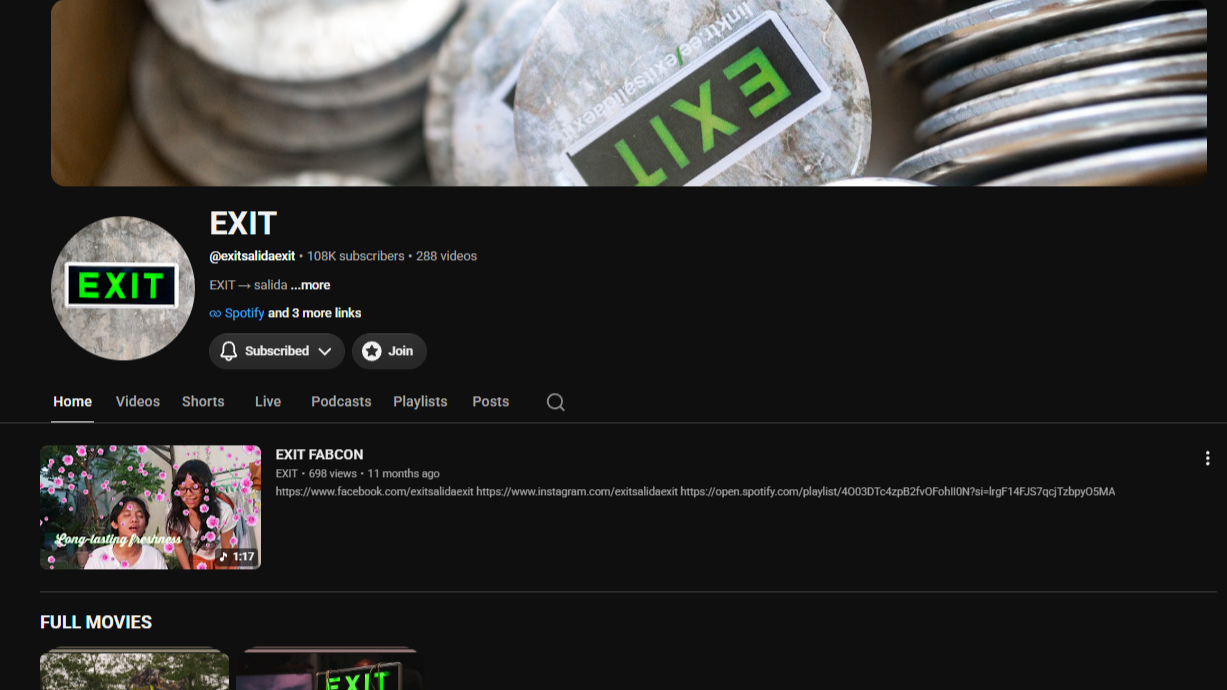
A screencap of EXIT’s YouTube homepage
EXIT is a YouTube channel envisioned as a kind of digital retirement center for local independent films—works that may no longer be actively circulating in festivals but remain valuable pieces of Philippine cinema, ready to find new audiences online while creating new opportunities for filmmakers to benefit from their work.
According to Cebuano filmmaker and EXIT founder Keith Deligero, the concept behind EXIT began with an unexpected encounter in the mid-2000s when he noticed a Spanish signage in a parking lot: entrada for "entrance" and salida for "exit." The word salida immediately caught his attention because of its connection to the Filipino word palabas, which is a term that refers both to "the show" and what is presented or projected on a cinema screen.
The name later took on an even deeper meaning. During the film industry's transition from celluloid to digital projection, filmmakers often joked that cinemas projected Hollywood blockbusters at full brightness while local films were slightly dimmed to prolong the life of expensive projector lamps. It may have been fact or an urban legend, but the image stuck: an EXIT sign glowing more brightly than the movie on screen.
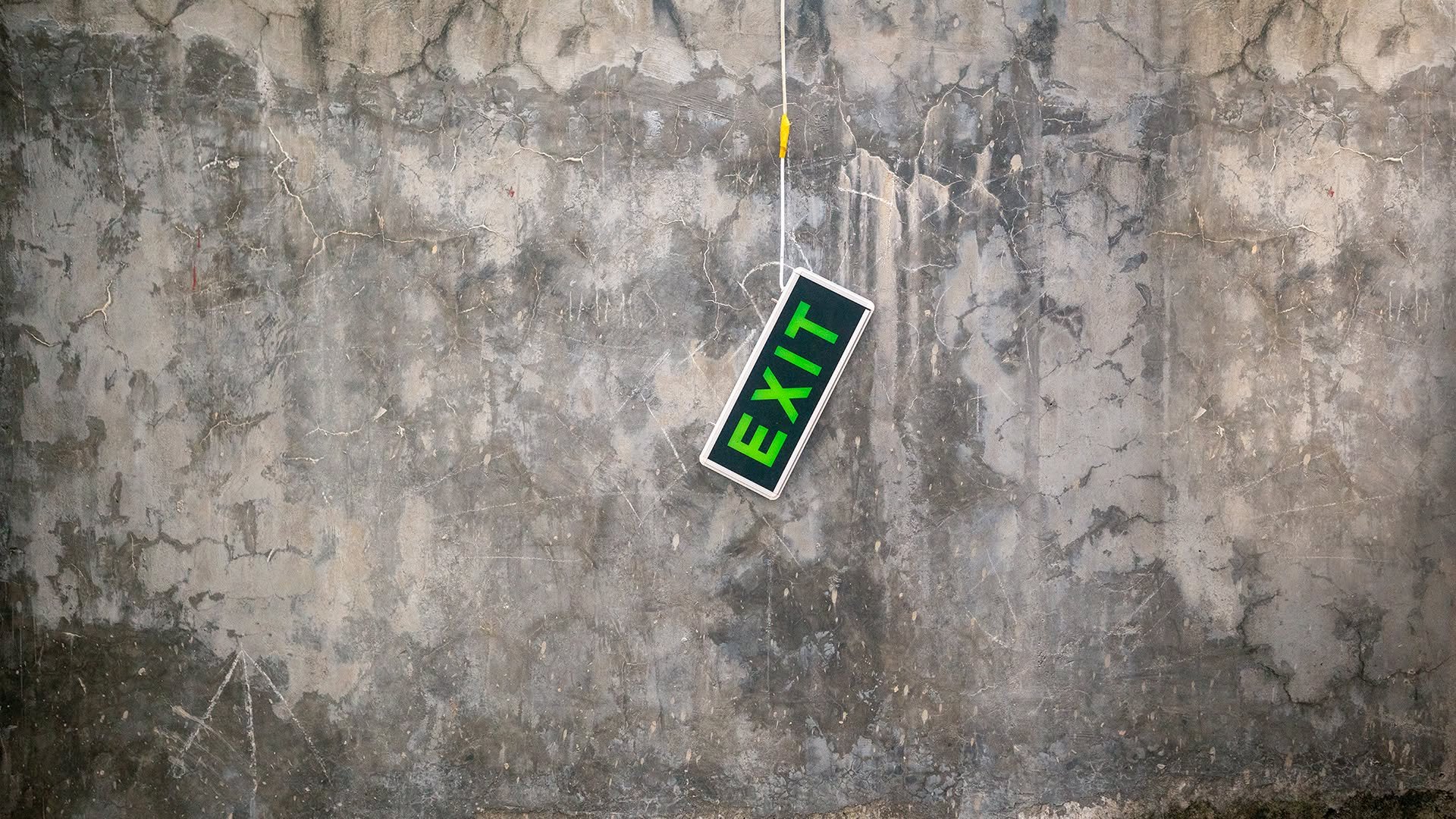
Its iconic green title and logo | Photo courtesy of EXIT Facebook page
The history of EXIT is not a straight line, but an evolving journey shaped by different forms of film exhibition, from print to digital platform.
The name first appeared in 2014 as a zine dedicated to film articles, essays, and festival coverage. The publication eventually found a new home when it was integrated into the Sinekultura journal of the University of San Carlos in Cebu City.
During the COVID-19 pandemic, EXIT took on a new form as an online screening initiative through KTX, ABS-CBN's digital ticketing platform. The project presented curated programs such as Best of BINISAYA and the Adlaw-Adlaw series for a limited time.
Moving online created new possibilities for accessibility, allowing regional and independent films to reach audiences across the Philippines at a time when physical screenings were impossible. It also revealed the potential of digital platforms as alternative spaces for films that might otherwise be overlooked.
The next chapter of EXIT began when Keith Deligero partnered with Christian Naparota's inactive YouTube channel, which originally housed Zombie Slash Wak-wak, a viral Bisaya short film and zombie musical from Bohol released in the early 2010s. The film has already accumulated 36 million views on YouTube as of this writing. However, the channel had become inactive so Deligero took over and repurposed it into a new home.
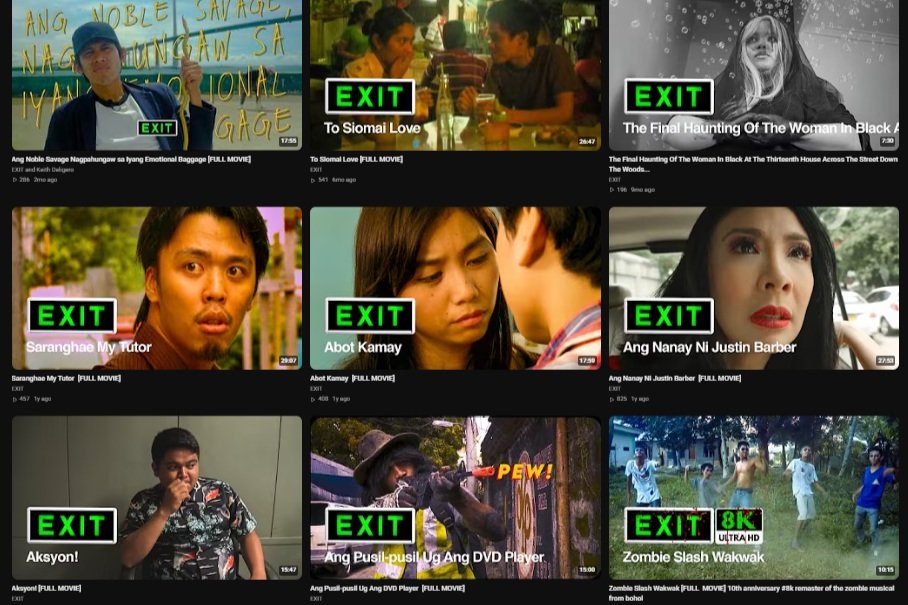
A compilation of local short films available on the EXIT channel
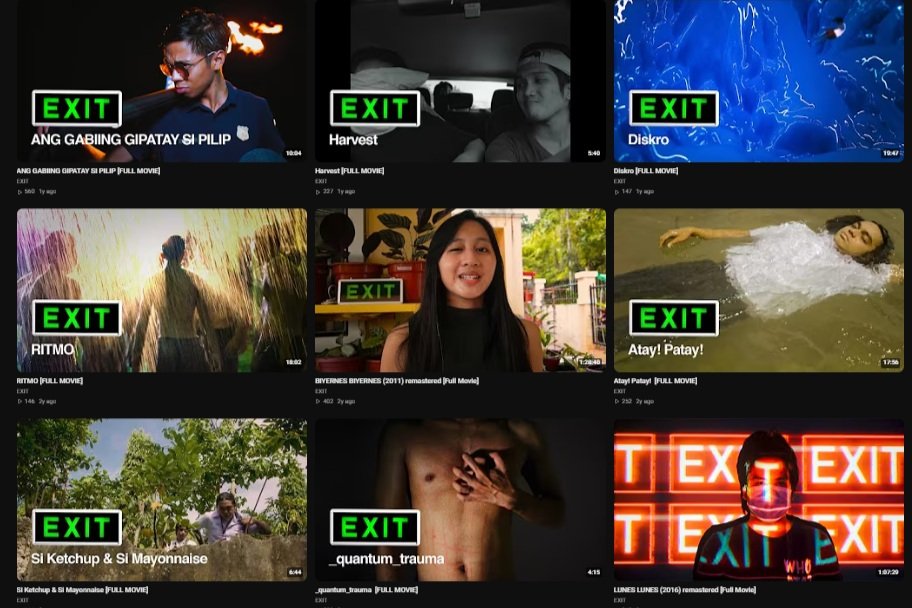
Today, EXIT has found its most accessible home on YouTube, where it continues to grow as both an exhibition platform and a living archive of Philippine independent cinema.
Its catalog brings together pioneering Bisaya shorts made by iconic Bisaya filmmakers such as To Siomai Love by Remton Zuasola, Ang Nanay ni Justin Barber, and Saranghae My Tutor by Victor Villanueva, alongside acclaimed BINISAYA selections from the past including Frank Go's Aksyon!, Redh Honoriez's Ang Pusil-Pusil ug ang DVD Player, and Jannah Corrine's Atay! Patay!
The channel also features recent BINISAYA winners, including Ang Noble Savage, Nagpahungaw sa Iyang Emotional Baggage by Mico Minerva, alongside regional films that reached national audiences as official selections of Cinemalaya, such as Duwa Duwa by Nena Jane Achacoso. Beyond the Visayas, audiences can also discover independent works from other parts of the archipelago, including Jaime Morados’ earlier films Almusal and Protacio and the Bum.
Completing the collection is the acclaimed Adlaw-Adlaw anthology series, featuring segments made by Cebuano filmmakers: Biyernes Biyernes (2011), Sabado Sabado (2012), Lunes Lunes (2016), and Martes Martes (2017). Together, they form a body of work that captures everyday Filipino life through an evolving cinematic experiment.
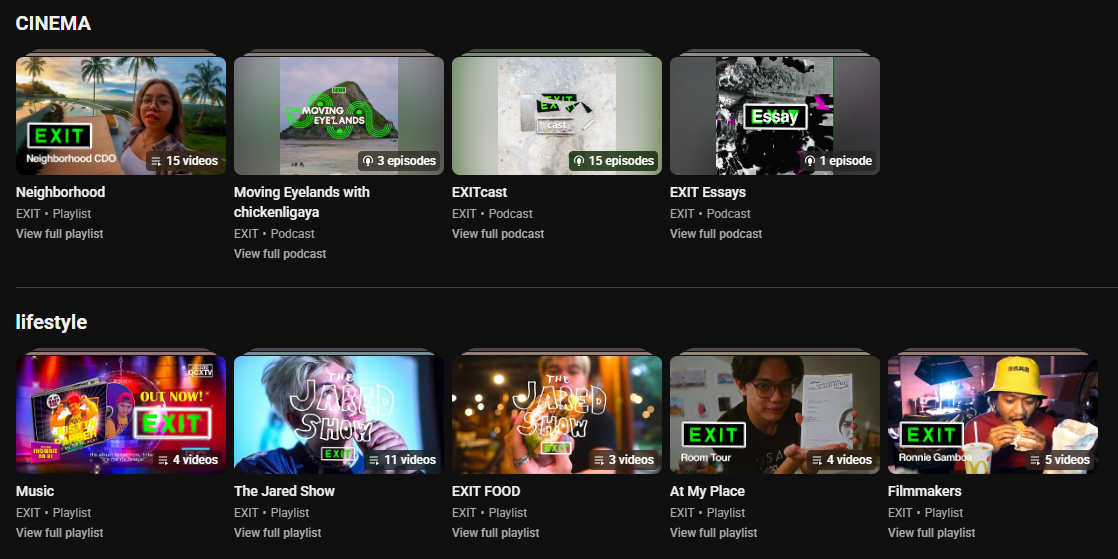
The channel also features other forms of entertainment, including vlogs, music, video podcasts, film festival reports, and more
At its heart, the EXIT channel is an attempt to answer one persistent question that follows every independent film screening: "Asa naman ni matan-aw ang salida?" (Where can we watch the film now?). It is also, in many ways, a quiet political statement against a distribution system that often leaves regional and independent films with little chance of reaching audiences.
Cinema was never meant to be reduced to mere content; its promise has always been the shared theatrical experience, something that cannot be fully replicated in a living room. Yet when that theatrical life ends, a film should not simply disappear.
An EXIT can also be an entrance—a way for films to find their way back to audiences.
The EXIT channel is currently streaming selected official entries of the BINISAYA International Film Festival 2026 through SAKSAKSINAGOL for a limited viewing period from August 17–21, 2026. The film with the highest number of views will be named the festival’s Audience Choice Award winner.