
‘Botan Kamiina Fully Blossoms When Drunk’ REVIEW: A Sip of Life

Socializing and forming bonds in college is hard. Take it not only from me (who, at the time of this writing, is a fourth-year college student), but from college dorm assistant and fellow student Ibuki Tonami (Yoshino Aoyama, Bocchi the Rock!), who prefers to keep to herself when it comes to her favorite pastime, drinking alcohol, after an unfortunate series of events in the past.
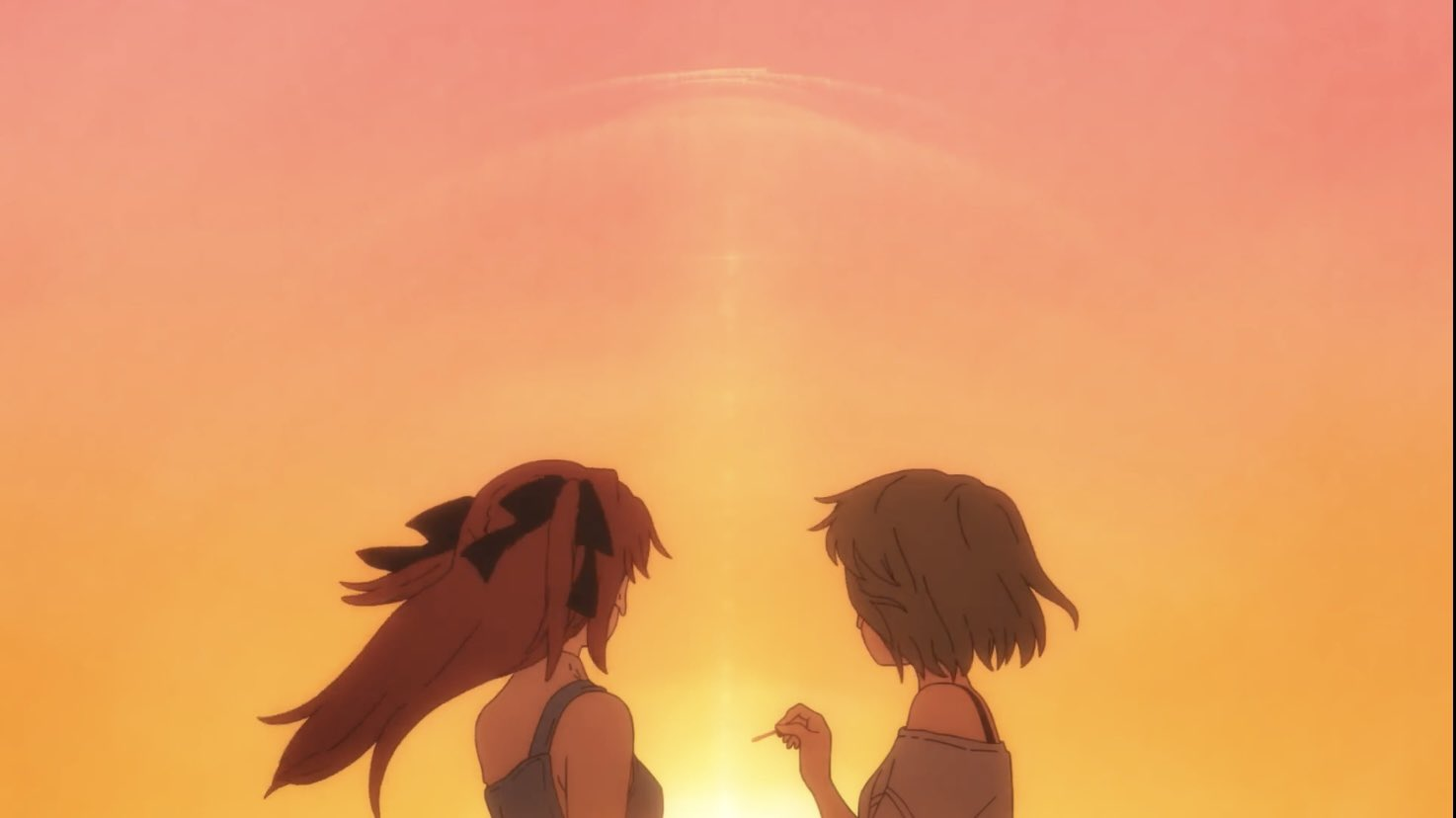
Botan and Ibuki sharing a moment in the sun / Photo still from show proper

Although she rather enjoys this alone time, free of judgement, it is only when she meets energetic and eager first year student Botan Kamiina (Sayumi Suzushiro, You and I are Polar Opposites), who is willing to also get into hobby drinking — and perhaps also into drunk flirting with her RA — that Ibuki begins to wonder if her own little interest could aid in allowing her and Botan’s kinship to develop into something more. Meanwhile, the fellow residents of the Saitama dorm they are staying in are also at their own crossroads, but perhaps they too could find connections through the things they love.
While Botan Kamiina Fully Blossoms When Drunk has its title paint a picture of a show that primarily focuses on a singular hobby or gimmick, what it really is at its core once it fully unveils is a serene and emotionally intelligent slice-of-life show about traversing the internal turmoil, ardent romantic yearning, and seeking of connection that comes with queer young adulthood.
There is a certain groundedness to the show’s atmosphere, which is owed to director Takashi Sakuma, who emphasized a more pleasant, at-ease sensation for the first episode. Although it does permeate throughout the show in a way that Sakuma describes as important to character dynamics, it allows a certain gravitas to the cast and their headspace. The lack of inherent propulsion helps each moment marinate not only within the characters, but within the viewers as well, adding dimension to an initial pitch that could’ve been more one-dimensional for an entire cour.
It also helps that the visual direction itself refuses to be boxed into a singular mode. In a surprising pivot from anime industry standards, Botan doesn’t have one chief animation director to oversee the entirety of its run, leaving the discretion to its individual episode directors and staff to imbue the show with their own distinct stamp.
Although these inconsistencies might stick out to others like a sore thumb, there is an unabashed auteur sensibility in this approach that allows each episode to be a platform for subtle, yet impactful stylistic exercises for notable animators, storyboarders and directors in the industry young and old (with contributions from Yusuke Yamamoto (Welcome to the NHK!), Masaomi Andou (Gakkou Gurashi!), and Souta Ueno under the pseudonym ‘Magnific Singer Mel’ (SHIBOYUGI) among many others). It’s a deliberate, meaningful show of scattered freedom befitting the show’s setting and the characters’ dilemmas.
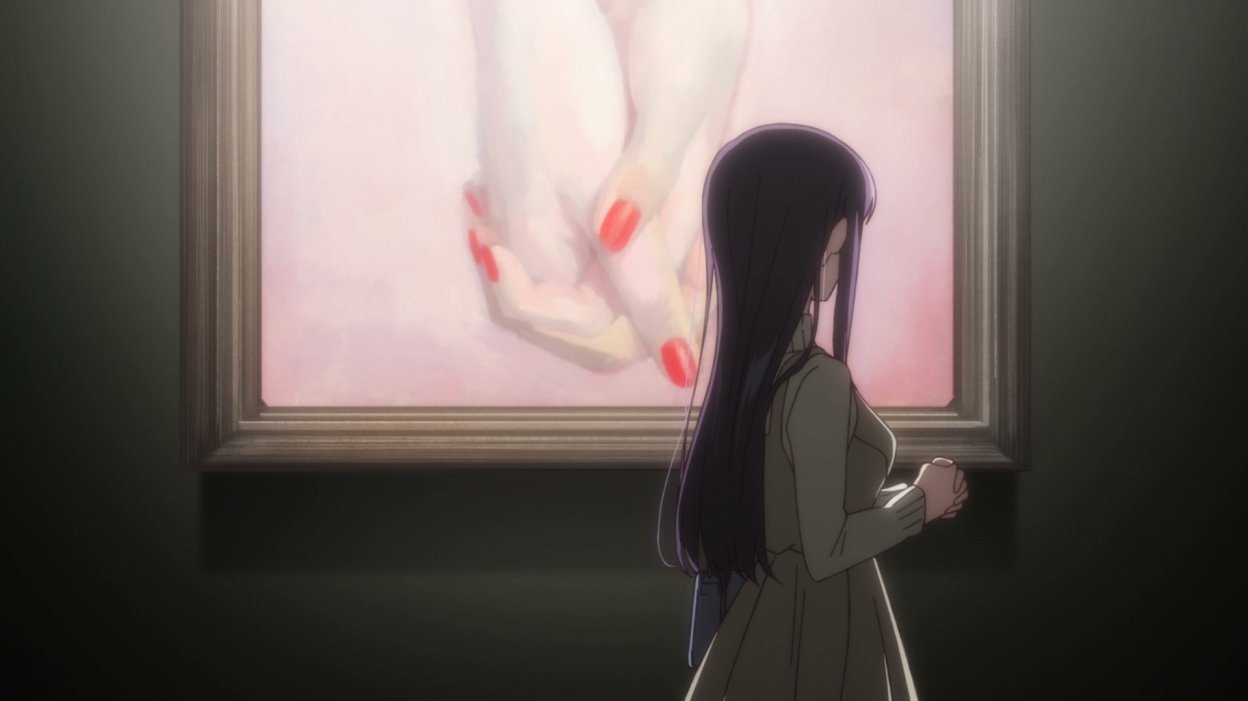
Gujou looking at an artwork, a facsimile of intimacy / Photo still from show proper
These dilemmas, beneath the random shenanigans and romantic tension that permeate this friend group, are based on the inherent complexity of how we, as people, try to get to know others and the conduits in which we try to do so.
Sure, it’s amusing to see these subplots playout — from Botan often getting a bit too up close and personal with Ibuki who, at first, remains unsure how to interpret her own growing feelings; or how sympathetically awkward upperclassman Kanade Gujou (Minako Kotobuki, K-On!) is when it comes to approaching her unrequited crush for the latter, to the arrival of exchange student Chang Chin-lan (Maki Kawase, Zombieland Saga) to the dorm and how it influences her own views of romance, and even seeing the admittedly cute random quarrels between ‘for-a-while’ couple Yaeka Kitamori (Miyu Tomita, Gabriel Dropout) and Akane Yusa (Yurina Amami, Umamusume: Cinderella Grey) — but all of them are tied into a very human scouring of bonds amidst the turbulent, changing direction of life, and what these bonds and the conduits they are made from mean.
Aside from the aforementioned gravitas, there is also a blunt straightforward tackling when it comes to the characters’ queerness, and how that factors into the boundaries between friendship and romance that provides a lot of the second half’s nuanced developments that fall under the themes of direction and uncertainty that feels all too heartfelt, with a payoff to all the very intimate romantic tension throughout the series that feels very earned.
The indisputable aspect that the show truly lets its threads bloom is its investment in the characters’ specific fixations and their intricacies. This not only applies to alcohol, but to a wide variety of interests and art forms such as literature, film, music, visual art, flowers, and even fragrances, among many others. While you can say that the various tangents the characters go on at times are opportune indulgences for original mangaka Hey! to mention their favorite pieces of media there is a legitimate investment in how these interests, and the conversations around them, either shape or inform their past experiences, perspectives, and current innermost feelings, while also bringing up the fascinating question of “who are we beyond what we love?”
It also helps that said references actually pull pretty deep and specific without just feeling like a checklist of familiar names, which adds to the sense of personality on a literary and psychological front. There is an early scene where a character brings out an indie alt-rock record, and the sensory experience that comes with it is an immediate, experiential standout.
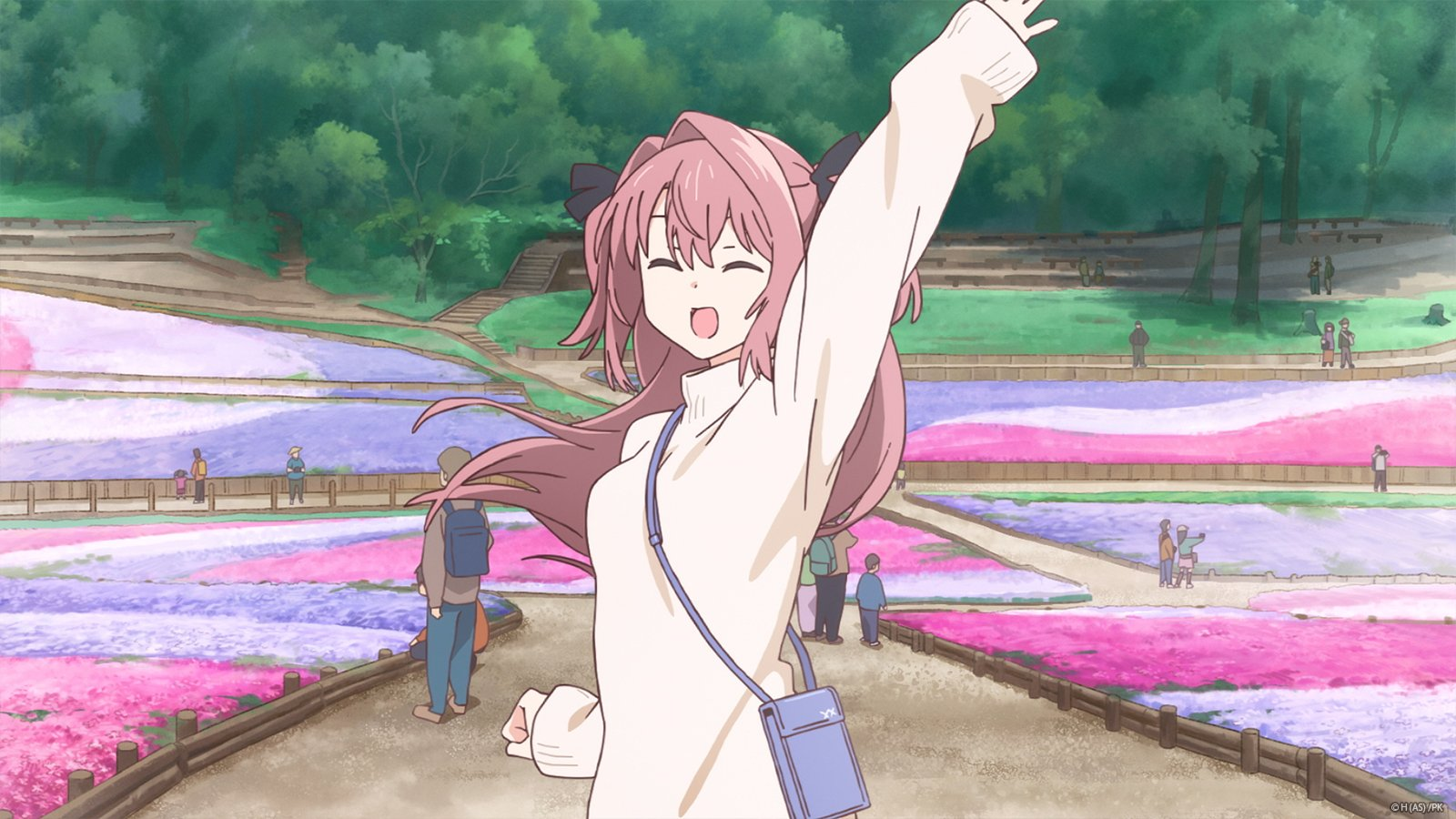
Botan in a field of flowers / Photo still from show proper
As someone who has formed several close friendships with others that initially stemmed from sharing the same interests, and whose feeling of affection is also built on sharing and discussing our personal loves and hates, the way Botan progresses its characters through these mundane exchanges of dialogue truly did resonate with me. Although I was a bit surprised at how much these characters can afford to support their hobbies, it’s less of a trifle and more of a fascinating insularity and reminder of how much I have to save often, while also keeping me impressed by the level of astuteness that they bring to an already investing emotional core. Never has there been a moment where someone claiming they watched an Edward Yang film to another be this romantic until this show.
In the middle of an already-crowded anime space filled with multiple IPs and auteur projects, there’s something about Botan Kamiina Fully Blossoms When Drunk that feels refreshingly tranquil in its vitality. Its disarmingly unassuming aesthetic belies an unabashedly sapphic, interpersonally insightful, and wholeheartedly genuine craftwork that believes in the capacity of alcohol, art, and a lot more to help light the way in the increasingly widening pathway of college life.
In its all-encompassing view of how love blooms, I truly do believe this show has spoken to me at perhaps the right time in my life, even as a non-drinker, and I truly hope it does for other people, because this series really is something special in its light-footed ingenuity. You don’t even have to take me at my specific words or really view everything I wrote about as a guide, for the art is right here to experience.
‘Botan Kamiina Fully Blossoms When Drunk’ is available to watch on Bilibili and iQIYI through Muse Philippines.