
‘Resident Evil’ REVIEW: Zach Cregger captures your brain on survival horror
‘Resident Evil’ REVIEW: Zach Cregger captures your brain on survival horror

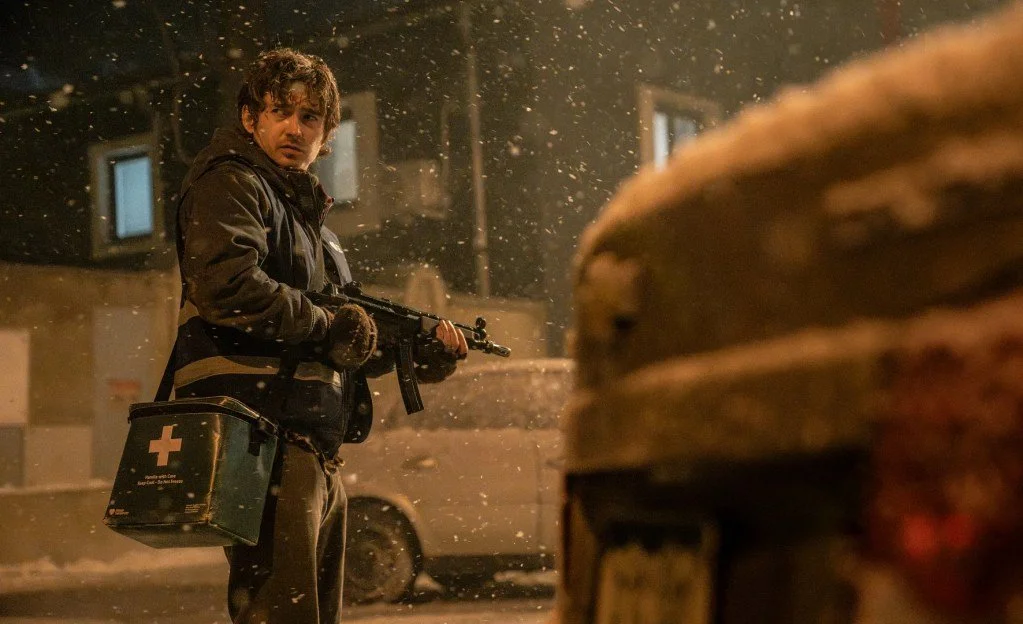
Austin Abrams as Bryan / Photo courtesy of Sony Pictures

Let’s get something out of the way first. Zach Cregger’s film adaptation of Capcom’s massively popular survival horror franchise, Resident Evil, plays very loose with the mythology of the games. He has already said that he won’t bring familiar characters or their storylines into the fold, but if you’re a hardcore fan expecting at least the places you once explored and the monsters that stalked you through the rain-soaked, zombie-ridden locales of Raccoon City, you might have to recalibrate your expectations just a bit.
That might sound like a red flag, especially for a franchise whose adaptations have long struggled with what exactly “faithful” is supposed to mean. Paul W. S. Anderson and Milla Jovovich’s live-action Resident Evil films, while retaining some familiar characters and iconic monsters, swing the pendulum far away from survival horror and into the realm of nu-metal B-movie superhero action, which, to be fair, has a charm of its own.
Johannes Roberts’ Resident Evil: Welcome to Raccoon City, meanwhile, swings that pendulum hard in the opposite direction, practically drowning itself in the iconography and coming close to a 1:1 recreation of locations and scenarios from the first two games without much of the art direction that made them so striking. Yet it still bafflingly alters enough of the source material that it ends up stranded in this dead zone where it is neither satisfying as a cosplay recreation nor confident enough to become its own thing.
Cregger’s Resident Evil, on the other hand, follows Bryan (Austin Abrams), an unlucky medical courier who gets caught up in a nightmare scenario while trying to deliver precious cargo to Raccoon City. In doing so, the film does away with the franchise's established cast altogether and even the monsters that have become synonymous with the series, whether they be Lickers, Hunters, Tyrants, or other grotesque mutations. That looseness with the source material, however, does not come from a lack of affection for it. If anything, stepping away from the mythology allows him to get closer to something that previous adaptations have often missed: the experience of actually playing the games, both in the way they make you feel and in the anxious thought process that comes with moving through them.
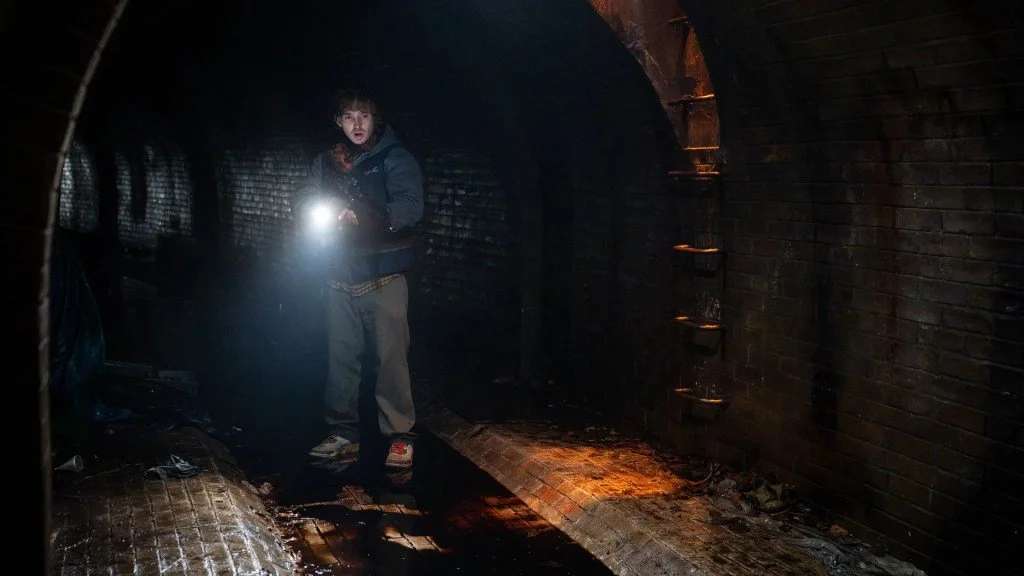
Bryan in the sewers / Photo courtesy of Sony Pictures
That fidelity first becomes apparent in the way Cregger translates one of its simplest but most effective design principles: turning the act of exploration itself into a source of dread. Much of Resident Evil, especially in its more horror-oriented entries, constantly forces you to push through your own fear by making you round corners where something terrifying might lurk, hesitantly open doors into the unknown, and venture deeper into dark corridors and areas filled with all kinds of environmental grotesqueries. It is a deceptively simple approach, one that teaches you to mistrust the very spaces you’re exploring and turns simply moving from one place to another into a confrontation with whatever your imagination tells you might be waiting there.
None of this is necessarily exclusive to the franchise. The dread of navigating spaces you cannot fully see has been part of survival horror since Infogrames’ Alone in the Dark and earlier Japanese horror games. But the series outlasted and outsold many of its contemporaries and helped redefine that language of fear across generations, to the point that it became inseparable from the experience of playing one. Cregger clearly understands that language, particularly the anxiety produced by what the image withholds, and recreates that same primal feeling through cinematography, lighting (or, at times, the lack of it), and sound.
The film is at its most unnerving in first-person or over-the-shoulder shots that peer into barely illuminated surroundings, revealing only fragments of what is there or glimpses of the carnage that has recently unfolded, while everything beyond their reach recedes into total darkness. And much like the games, the sound design punctures the stillness of these images with sudden and monstrous noises that can turn the sustained unease into bouts of panic.
Even the stalker enemy, traditionally used in the games to disrupt exploration and keep the player on their toes, is cleverly repurposed as the relentless engine that keeps the film moving. Its presence denies us the chance to simply stay put while keeping the sense of danger constant, forcing us deeper into Raccoon City until there is nowhere to go but forward.
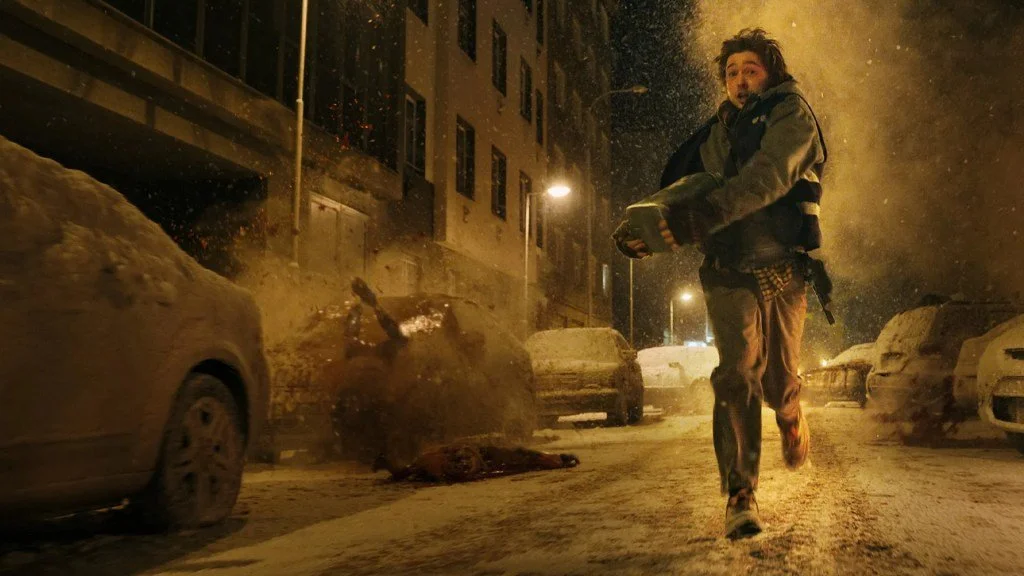
Bryan runs away from danger / Photo courtesy of Sony Pictures
But those are only some of the ways Cregger translates the games for the screen. He is just as interested in what it feels like to pick up a controller for the first time, only to realize immediately that you are woefully unprepared for what lies ahead. For as much as this is a Resident Evil film, it is still unmistakably Cregger, with much of its thrills and comedy coming from all the little indignities that come with being a newbie.
There is the struggle of landing a shot against an easy target, fumbling with ammunition as danger rapidly closes in, discarding something only to realize later that you badly need it, or constantly coming across another (in)convenient lock blocking your way through an area. Even the usual sense of video game progression, where better weapons gradually become available, becomes a playful jab at the player experience, since a stronger weapon means very little when the person holding it is still struggling to figure out how to use it.
It takes me back to my own introduction to Resident Evil, playing the original PC port of Resident Evil 4, where aiming with a mouse was not an option, and I had to wrestle with its awkward keyboard controls. Early in the game, Leon S. Kennedy walks into a village with little indication of what you are supposed to do beyond moving forward, only for the seemingly normal villagers to turn hostile and come after you, forcing you to fight for your life.
A chainsaw-wielding villager eventually joins the mob, making an already terrifying situation even worse. I remember panicking, missing shots, and making one bad decision after another, trying to find a way out, only for Leon to die over and over again. He might be a badass action hero, but he is only as badass as the person controlling him. Only after several attempts did I realize the whole point was simply to survive long enough for the ordeal to end. It made for a harrowing welcome to the series as a newcomer, but it’s also kind of hilarious to look back on now, knowing just how badly I handled those first few attempts.
That is essentially the joke Cregger finds in the games. There is just something inherently funny about watching someone else panic and fumble their way through the same things that stressed you out when you were the one playing. And the poor bastard tasked with embodying all of it is Austin Abrams, who described Bryan in an interview as “a little bit of a boy trying to be a man,” an apt description of both the character and his performance. Abrams fully commits to Bryan’s haplessness, mounting exasperation, and the fear of someone hopelessly out of his depth, never afraid to look scared, pathetic, or completely ridiculous.
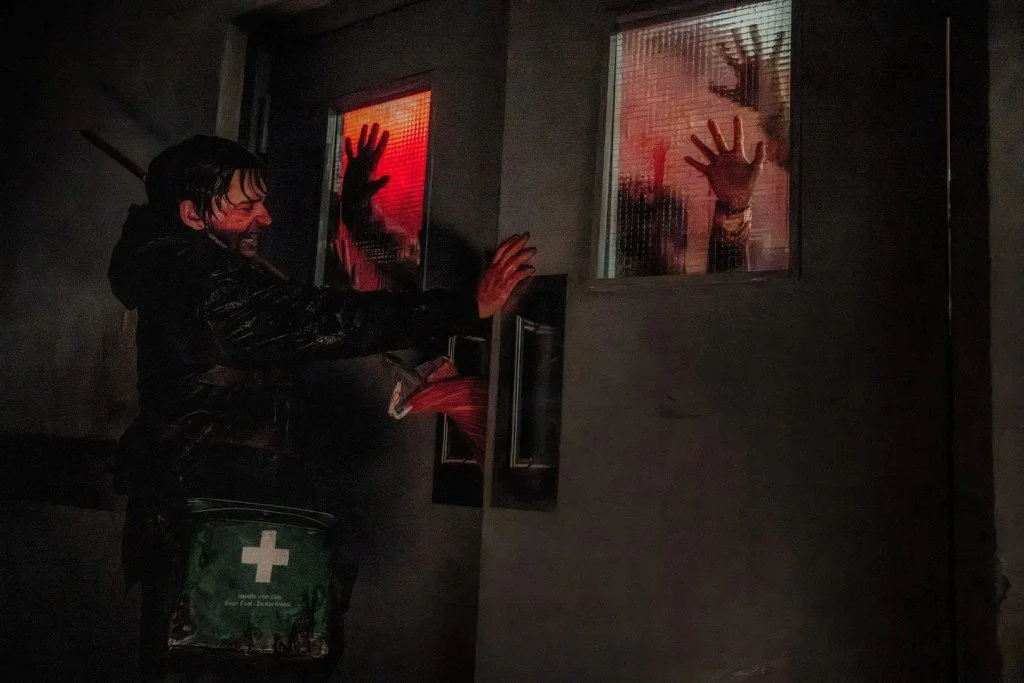
Bryan barricades himself against a horde of zombies / Photo courtesy of Sony Pictures
There is also an obvious Sam Raimi streak in the film’s treatment of Bryan. Like Raimi tormenting Bruce Campbell as Ash Williams, Cregger's plotting delights in making Bryan’s night progressively worse and turning his mounting misery into part of the comedy. In one of its best bits, even the music joins in on the bullying. Bryan carefully lines up a shot at a padlock from practically point-blank range as a drum roll builds, only to miss and have the score punctuate his failure with a percussive sting. The film doesn't just show how he screwed up. It also rubs it in.
The difference is that Abrams never pushes Bryan into the same cartoon slapstick as Bruce Campbell. Ash eventually gets to turn all that suffering into bravado; Bryan is just a guy who is tired, scared, and increasingly fed up that the night refuses to end. Much of the humor comes in the way he processes all this abuse: the squeak in his screams, the bewilderment on his face whenever another horror presents itself, and the growing irritation that bursts into a whole lot of expletives. He isn’t the hero of a Resident Evil game. He’s the externalized thought process of the person holding the controller, trying to keep it together as everything goes wrong. It all makes for one hell of a fun horror comedy in the vein of Raimi’s Evil Dead II or Drag Me to Hell, as well as Cregger’s own Barbarian and Weapons, the kind that can have you tense one moment and laughing at the absurdity of whatever fresh nightmare has just unfolded the next.
I did occasionally wish Cregger had given us more of the film’s freakier creatures, particularly one hideous mutant baby that disappears almost as quickly as it appears. But that restraint begins to make more sense as it winds toward its final cruel turn, as though he had been saving some of his nastiest impulses for one last joke at Bryan’s expense. Without giving away where it goes, it makes for a gleefully nihilistic yet oddly beautiful and tragic (thanks to brothers Hays and Ryan Holladay’s score) punchline to everything Bryan has endured.
For all the liberties Cregger takes, there is something affectionate in the way he remembers what Resident Evil asks of the people who play it. Not merely that we survive whatever nightmare waits on the other side of the door, but that we stumble our way through it, get scared, get annoyed, screw up, somehow make it out by the skin of our teeth and have a lot of fun doing it. That is why, despite straying far from the established iconography, the film can still feel strangely familiar.
It is certainly a love letter to Resident Evil, but perhaps even more so to the poor bastard on the other side of the screen.
‘Resident Evil’ is now showing in Philippine cinemas.