
‘Marty Supreme’ REVIEW: Greatness is Built at a Cost

‘Marty Supreme’ REVIEW: Greatness is Built at a Cost

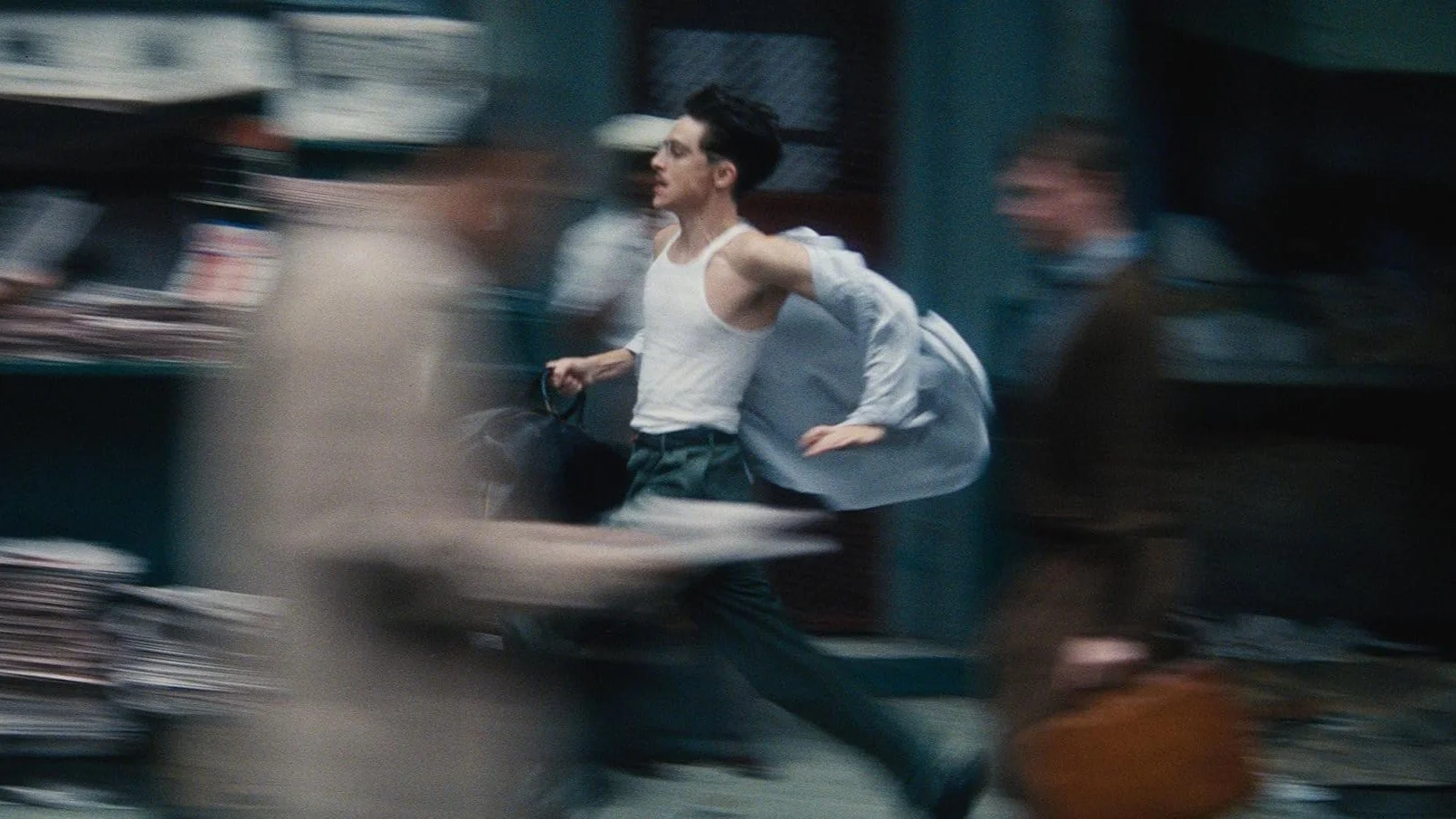
Marty Mauser (Timothée Chalamet) runs through the busy streets of New York | Still courtesy of A24.

The idea of greatness rarely allows itself to be incidental; it demands pursuit. By that logic, relentless effort becomes a baseline expectation and, above all, survival depends on how convincingly one can aestheticize the cost. Marty Mauser is surely up to that challenge: a smug table tennis prodigy living in 1950s New York, determined to prove that the booming sport will be as big as he is, attempting to win the British Open while commanding — not once, but twice — that whoever stands before him should look at him. Or, in most cases, the world itself, too.
And as viewers, it’s easy to look at him. The sleek charisma. The sharply tailored sense of style. Even more enjoyable are his roundabouts of self-proclamations. From even a single line from Marty’s mouth, Timothée Chalamet embodies a character drunk with half-delusions so fully that it seems that it's the earliest blueprint from which the Safdie brothers' written characters sprang, but it's not.
As Josh Safdie’s first creative project after pausing his filmmaking partnership with Benny Safdie, Marty Supreme retains the frenetic whips of misadventures that defined the brothers’ modern classics like Uncut Gems and Good Time. The narcissist remains, now operating with amplified charisma through Marty. His character's two matching arcs — one of indirect self-destruction, the other driven by a relentless urge to win — develop with the same manic energy, expressed through a more playful and energetic register. Some scenes pull me in with the sheer force of his confidence, while others leave me appalled at its audacity. I feel grateful, in turn, not to carry any of it myself.
The spine that makes this experience so immersive is carried by Chalamet’s performance. Watching the film, the debate over his bold claim to greatness at the 2025 SAG Awards (now called The Actor Awards) only underscores what makes him such an impressive actor. He didn’t just prove it; he owned it entirely. His performance as Marty not only drives the narrative but is inseparable from its very quality. He lends the character an energy so irresistible that witnessing this despicable man win and immediately trip over his arrogance is addictive. Arguably, it is Chalamet’s most accomplished performance to date.
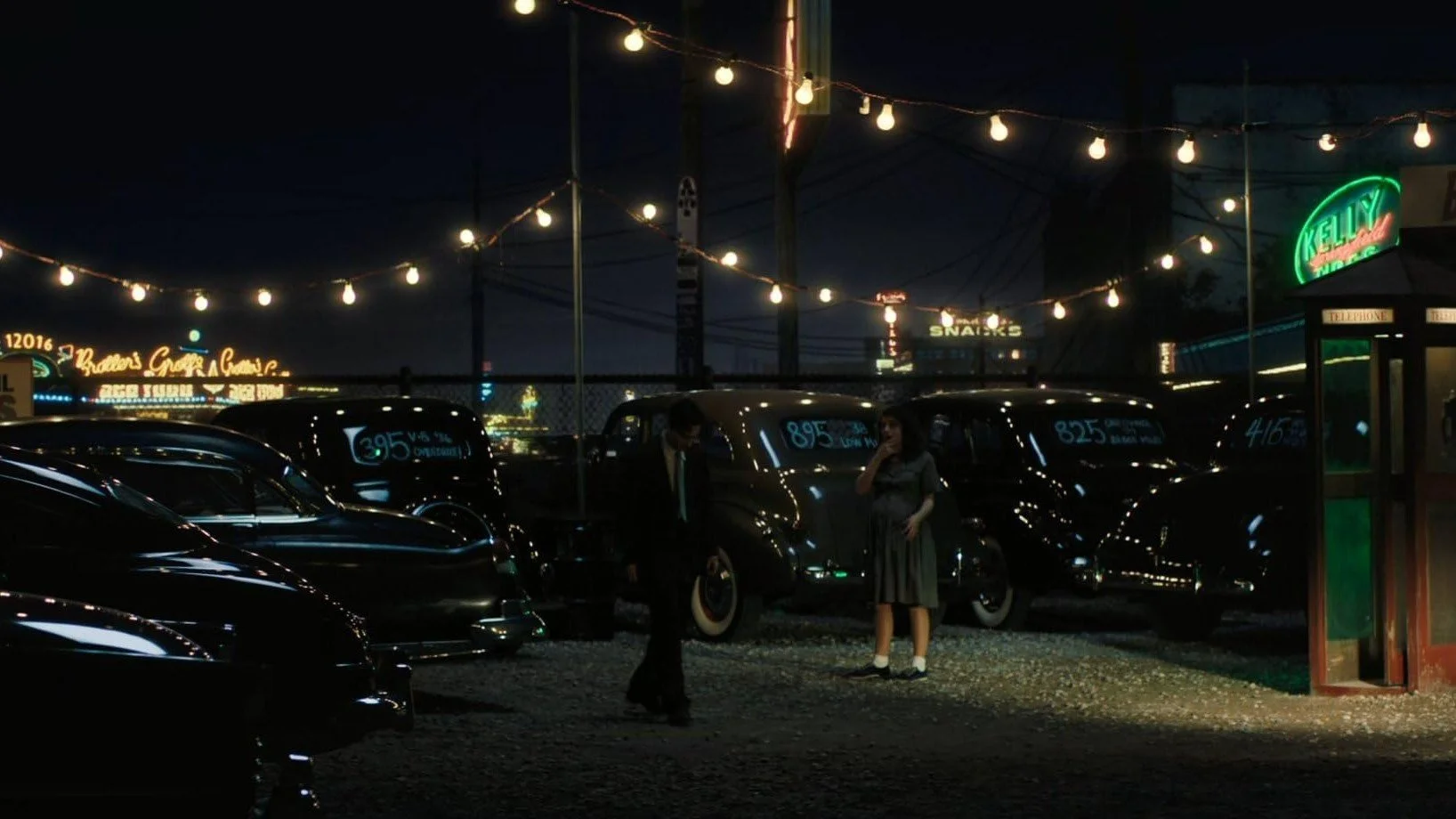
Timothée Chalamet and Odessa A'zion in Marty Supreme | Still courtesy of A24
From the opening moments, his inflections as Marty are every bit as punchy as his wide-pleated pants, which have surely grown tired of flailing around shoe boxes as he tries to escape his stable job as a salesman to chase his table tennis dreams. But, of course, as the chosen prodigy he is, Marty doesn’t forget to degrade his co-worker and adopt the assertive tone his boss clearly lacks. He can even wield two kinds of guns: one for blackmail, the other for a quick plea. Not exactly the least obnoxious metaphor, but the opening sequence proves how absurdly goofy it can get. Those swimming sperms? Definitely a choice.
From then on, the brakes outlive the rails. Marty Supreme starts at full throttle and never lets the friction die in any of its sequences, albeit occasionally bogged down by repetitive narrative throughlines of misfires. The spontaneous romp — uncontainable hunger and cascading bad decisions — ricochets across the many rooms, foreign lands, and egos Marty barrels through. This rendition of New York is so visually crisp that it's easy to be pulled by sheer atmosphere alone.
The production designer, Jack Fisk, whose Hollywood reputation rests not on overt flashiness but on a dedication to authentic texture and immersion, proves this early on.
The film’s opening shoe store scene exemplifies this perfectly, with each box said to be rendered in heavy detail, anchoring both the mood and period accuracy in a moment that barely occupies any significant runtime. This attention to craft is reinforced by legendary cinematographer Darius Khondji, who shot the film largely on 35 mm and on anamorphic lenses, producing a look that feels so timelessly rewarding to engulf in. Carefully framed compositions, stark lighting, and deliberate zooms further elevate the story’s hectic fizzles of chaos, a continuous thrust of adrenaline complemented by Daniel Lopatin’s masterful curation in his soundtrack for the film, which stands out even when experienced in isolation.
In Marty Supreme, detail is as vital as performance, and the cast stands as one of the film’s most captured strengths. Chalamet’s energy does not simply dominate the frame; it bounces off an ensemble attuned to his tempo, actors who meet him at the same restless pitch. Each character carries distinct desires, but all move along the same receding horizon of pursuit. They mirror, intersect, and magnify one another’s tendencies until the question surfaces: was any of it worth the exchange? To ask this, the film furnishes us not only with Marty but also with a constellation of characters substantial enough to wrestle with those doubts alongside him.
His childhood "friend," Rachel Mizler, played by the wonderful Odessa A'zion, serves as a calculated counterweight, confronting Marty’s narcissism on its own slippery terms. Gwyneth Paltrow fittingly reemerges as Kay Stone, a once-luminous actress clawing her way back to relevance, bringing with her a self-awareness that cuts both ways. Her husband, Milton Rockwell, played by Kevin O'Leary, presides over a corporate empire and eagerly bankrolls both his wife’s return and Marty’s opportunistic marketing schemes, transaction as a lifeblood of a vampire. And for an unexpected flash of charisma, Tyler Okonma / Tyler, the Creator, makes a great acting debut as one of Marty’s close acquaintances, exuding a magnetism similar to his jolting concerts that lingers even in limited screen time. And of course, Abel Ferrara arrives with a looming presence that ushers in one of the grittiest and blissfully inane detours in the film’s storyline, a sudden uptick in tempo that tilts the narrative into murkier territory.
This is the biggest budget a Safdie film has ever had, and despite its considerable runtime, it largely feels justified: the ensemble is afforded equal breathing room, the scale hangs thick in the air, and each character’s arc arrives at a satisfying resolution in one way or another. That expansiveness, however, comes at a cost. A few side plots grow wearisome in the back half, even as the ecstatic delirium of certain accidents remains perversely thrilling to watch. That said, the ending might have benefited from a more concentrated build-up rather than an escalation of bulked-up absurdities to stage its final sequence, an otherwise compelling footnote that neatly gathers the film’s themes but doesn’t fully earn the crescendo it aims for.
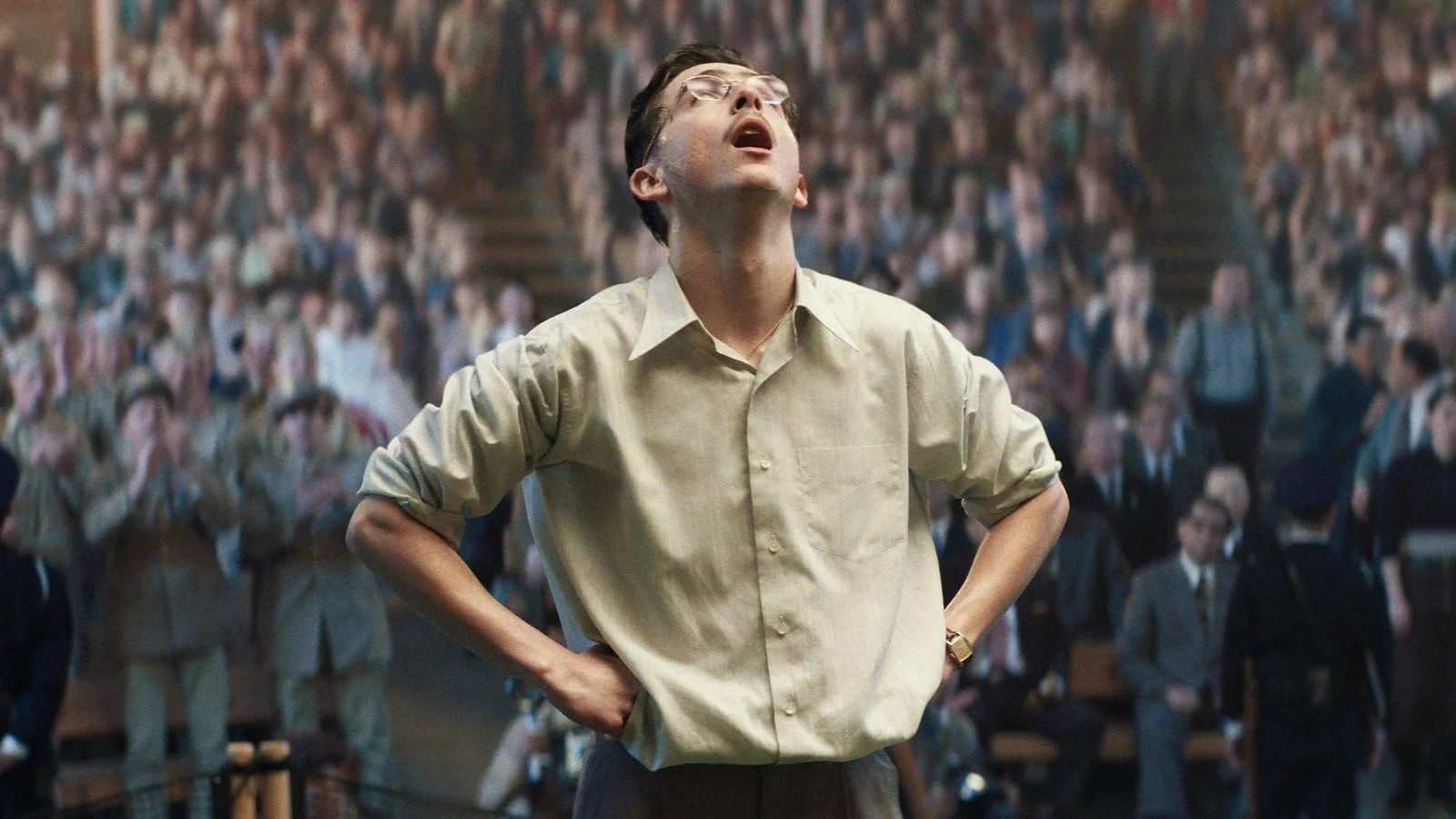
Marty gives his final sigh of relief | Still courtesy of A24
It’s one of my biggest gripes with the film, perhaps the only one. Every technical element topples into the service of another, and by the end, it becomes easy to forgive. At its center is the screenplay by Josh Safdie and Ronald Bronstein, which is impressively complex in the way it reveals character motivations and histories through the slightest behavioral shifts or the way a line is carried. There’s a wealth of rich subtext hovering within the dialogue — familial tensions and upbringing, marketability and performance, post-war collective trauma, and, most of all, a commentary on how we define greatness through the toll these particular trials exact.
For Marty, the self-proclaimed ultimate product of Hitler’s defeat, it’s every man for himself. From one viewpoint, the entire film is steeped in an inescapable sadness; our characters scramble in desperate measures to compensate for their external realities in any way they can. For Safdie, who made the film as a fraught confrontation with his own creative pursuits, once heavily doubted, the experience reads differently. With even the slightest nudge in perspective, it doesn’t have to remain a solitary man’s struggle. Their stories overlap in this regard: greatness is always within reach, if only through another way of seeing.
It doesn’t subvert the Safdie template, nor does it attempt to. In some ways, it’s better for that restraint; in others, slightly diminished by how structurally familiar it can feel, as if we already sense the turns before they arrive. The architecture is recognizable: the strenuous single-character spiral, the ever-mounting humiliations, and the suffocating forward propulsion toward an inevitable catharsis, whether redemptive or ruinous. We know this rhythm. However, familiarity here doesn’t directly translate to complacency. There is a clear spirit of devotion coursing through the film. So much love has been poured into it that even when the framework feels trite, the execution rarely does. The energy is still feverish. It is chaotic yet carefully modulated. What could have been mechanical instead feels lived-in, almost personal.
If it wasn’t already clear through A24’s razor-sharp marketing and relentless press circuit, Marty Supreme promised a great deal and, remarkably, it delivers on the inflated terms it sets for itself. In an era when the very act of going to the theater is constantly interrogated, when spectacle feels algorithmically manufactured, and when communal awe is increasingly rare, this is the kind of film that resists that fatalism. It justifies its scale. It earns its runtime. It reminds you why the darkroom still matters. There is so much to unpack and process — the performances, the conviction, the strength of its emotional swings — but above all, what remains solidly intact is something simpler and almost unfashionable to admit: greatness can still happen.