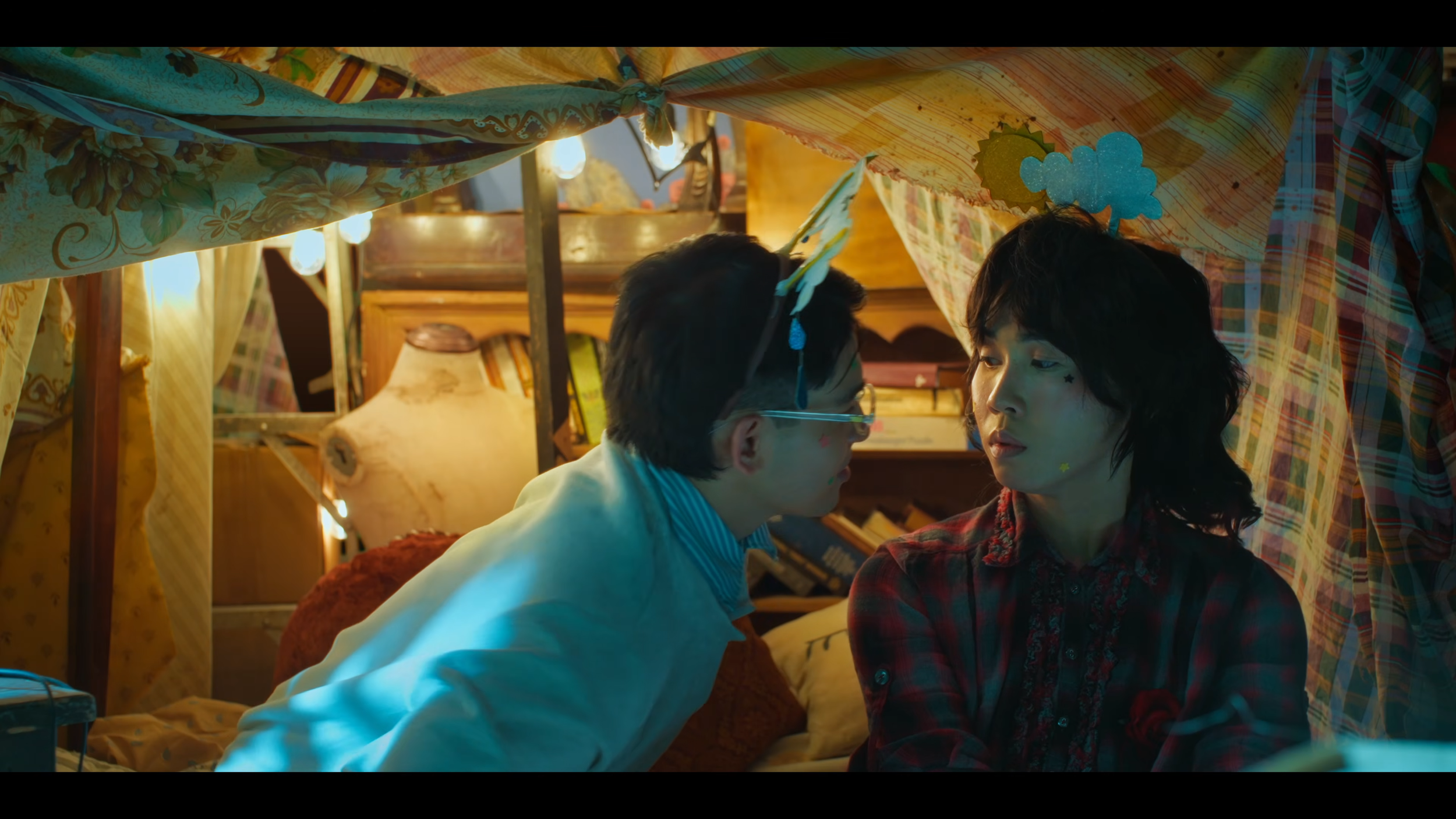

The Cruelty of the Articulate: Who Gets to Be Believed in ‘About Us But Not About Us’?

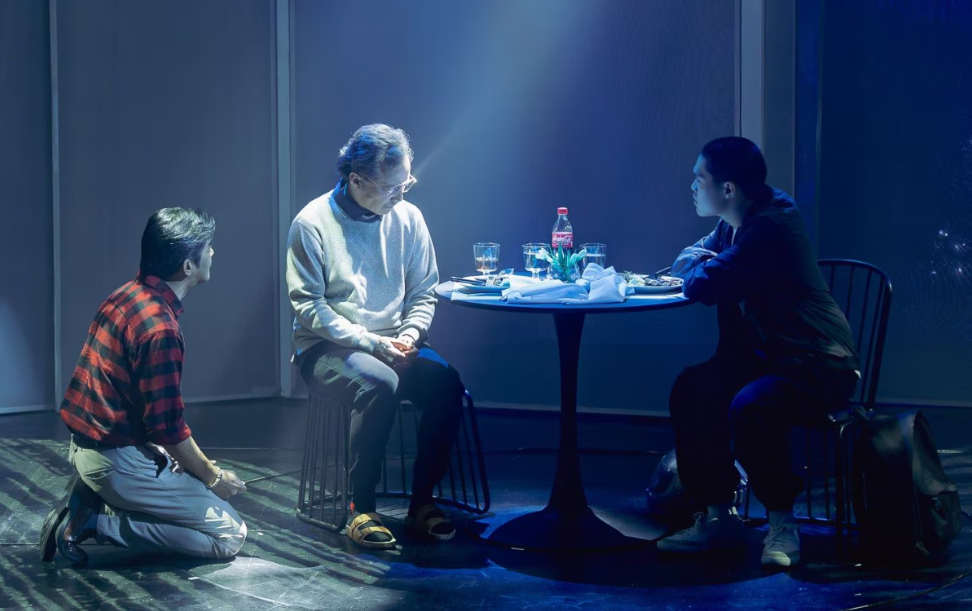
Romnick Sarmenta as Eric, Epy Quizon as Marcus, and Elijah Canlas as Lancelot / Photo courtesy of The IdeaFirst Company
There is something disarming about a person who knows exactly what to say. We tend to associate intelligence with good judgment, eloquence with credibility, and a convincing explanation with an honest one. Someone who can make sense of their suffering often seems more trustworthy than someone who struggles to explain theirs, yet the ability to put an experience into words says little about a person's innocence. People can understand the harm they cause and still find ways to justify it. They can explain their intentions so convincingly that the consequences of their actions begin to seem secondary. Perhaps the danger of eloquence lies in how easily a persuasive account can be mistaken for the whole truth.
The stage adaptation of Jun Robles Lana’s About Us But Not About Us, directed by Tuxqs Rutaquio, follows Eric , a literature professor, and Lancelot , his former student, as they reunite over a meal months after the untimely passing of Eric's longtime partner, Marcus.
What begins as an ordinary conversation gradually exposes the complicated relationships between the three men. Eric had previously allowed Lancelot to stay in his home during the pandemic, an arrangement Marcus opposed. As their conversation unfolds, revelations about their relationships, ambitions, and betrayals challenge what each man claims to know.
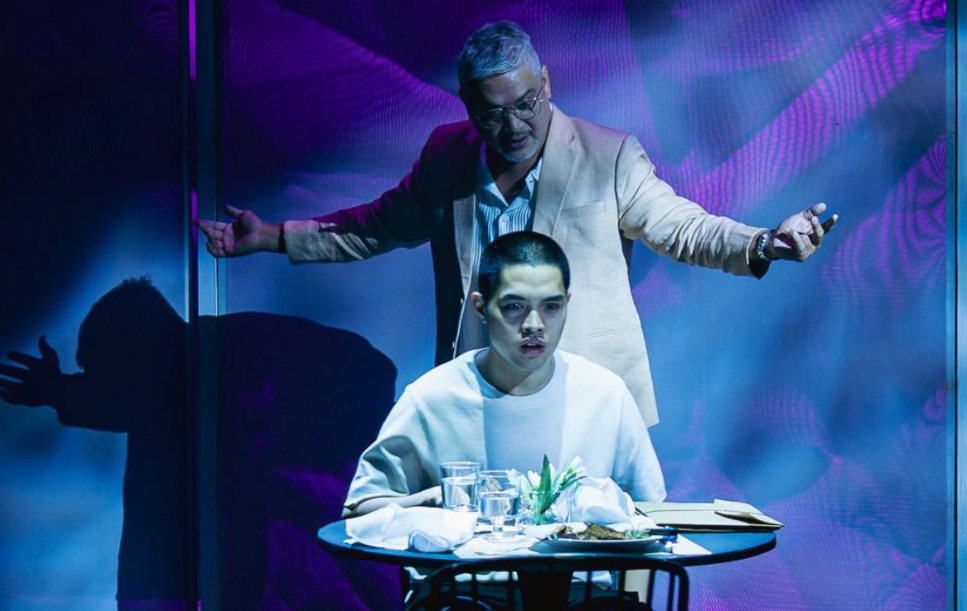
Andoy Ranay as Marcus and Elijah Canlas as Lancelot / Photo courtesy of The IdeaFirst Company
When Intelligence Begins to Look Like Innocence
The play is particularly interested in people who understand the power of words. Eric teaches literature, Marcus is an accomplished writer, and Lancelot is an aspiring one. Their familiarity with language gives them the means to interpret their experiences and challenge one another's accounts. Yet their intellectual abilities do little to protect them from jealousy, resentment, or manipulation. They understand how stories work, including how much depends on what is emphasized, withheld, or left open to interpretation.
The stage setting makes that tension harder to ignore. Eric and Lancelot spend much of the play facing one another in the same confined space, with little to distract from the conversation. Their words matter, but so do their reactions to them. A pause, a change in posture, or a shift in distance can make a confident explanation feel less secure. The audience is not only listening to what each man says but also watching how the other person receives it.
Eric’s position as a professor adds another layer to this imbalance. He can understand his decision to help Lancelot as an act of care, especially given Lancelot’s history of abuse. But his intention does not erase the difference in age, authority, and circumstance between them. The play allows that contradiction to remain uncomfortable. Eric may believe he was helping, while Lancelot may have experienced the relationship differently.
The distinction matters because people often judge their own conduct through intention while judging others through consequence. Eric's belief that he was helping Lancelot may be sincere, but sincerity doesn’t prevent a relationship from becoming complicated or harmful. His account deserves consideration without being granted automatic authority. The play gives us reason to examine the distance between how a person understands himself and how his actions affect others.
The Privilege of Being Believed
Lancelot complicates the issue further. His history of abuse makes his vulnerability real, but the play gradually reveals that he is also capable of calculation and manipulation. His youth doesn’t make him powerless in every interaction, just as Eric's seniority doesn’t give him complete control. Their exchanges repeatedly alter the audience's understanding of who holds the advantage.
The stage adaptation makes those shifts visible. The actors’ positions change as the conversation develops, and the physical relationship between them becomes part of the argument. A character who appears calm in one moment may seem cornered in the next. The movement does not replace the dialogue, but it gives the audience another way to read what is happening between them.
This is where the privilege of being believed becomes more complicated than the usual distinction between powerful adults and vulnerable young people. Eric possesses academic authority, while Lancelot can use his knowledge of Eric's desires and insecurities to challenge him. Each understands something about the other that can be turned to his advantage. Power shifts as the conversation progresses, although those shifts do not erase the unequal circumstances in which their relationship developed.
Their familiarity with literature also raises a more uncomfortable possibility: people who know how narratives are constructed may be especially skilled at presenting themselves favorably. A coherent explanation can arrange events into a sequence that makes harmful decisions appear reasonable or inevitable. It can direct attention toward a person's suffering while leaving the suffering they caused less examined. The explanation may contain genuine remorse and still conceal an unwillingness to accept responsibility.
When the Dead Can No Longer Answer Back
Marcus introduces another dimension to this struggle. As a celebrated writer and Eric's longtime partner, he holds intellectual and personal authority of his own. His objections to Lancelot's presence in their home emerge from a relationship already marked by insecurity and tension. His success also complicates his marriage to Eric, whose frustrations and ambitions become part of their shared history. Marcus is neither an impartial witness nor someone whose experience can be reduced to what the surviving characters say about him.
Marcus is where the stage adaptation makes its clearest departure from the film. While Eric and Lancelot discuss a man who can no longer respond to their accusations, the play also brings Marcus into the story through flashbacks that show parts of his life and his relationships with both men. These scenes allow the audience to see moments that would otherwise exist only through Eric and Lancelot’s recollections. Marcus still doesn’t become an unquestionable source of truth, but his physical presence gives the audience another perspective against which their versions of the past can be measured.
This makes grief an important part of the play's treatment of credibility. Eric has lost a partner, but that loss cannot establish the accuracy of his recollections. Lancelot has suffered in ways that help explain his behavior without excusing everything he does. Marcus, meanwhile, has his own grievances and limitations, which become harder to acknowledge when his life is discussed mainly through the circumstances of his death.
Grief can make people more sympathetic to us, sometimes for good reason. It can also discourage difficult questions about our conduct. When someone is mourning, criticism may seem cruel even when it concerns actions that deserve scrutiny. The play resists allowing suffering to resolve moral questions because its characters have experienced pain and have also contributed to the pain of others.
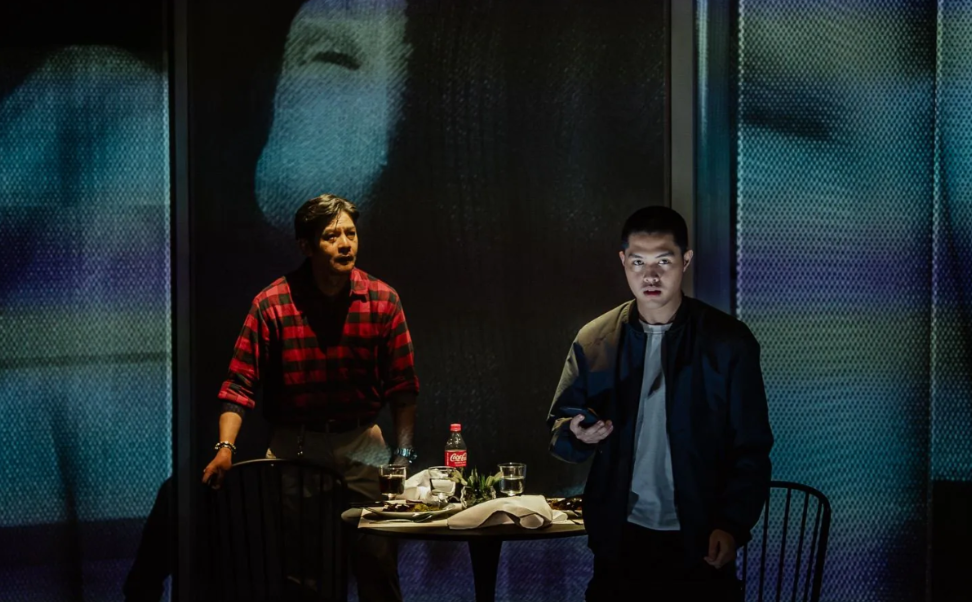
Romnick Sarmenta as Eric and Elijah Canlas as Lancelot / Photo Courtesy of The IdeaFirst Company
The Person Who Controls the Story
The importance of writing within the story becomes particularly clear through Marcus's attempt to produce a novel in Filipino. The manuscript carries different meanings for the three characters. Marcus approaches it as an opportunity to tell a story, while Eric fears what it might reveal and Lancelot sees its potential for his own literary ambitions. A piece of writing becomes entangled with questions of exposure, recognition, and control. Whoever determines how the story is told may also influence how the people involved will be understood.
There is a revealing irony in the fact that these men devote themselves to literature, a discipline that requires close reading and an awareness of competing interpretations. Their ability to recognize complexity in writing doesn’t necessarily make them more generous in their relationships. They can scrutinize another person's words while remaining protective of their own version of events. Intellectual sophistication offers no guarantee of emotional maturity.
The production's use of English reinforces the characters' shared academic environment. Their conversations often sound controlled even as the relationships beneath them grow increasingly unstable. Their vocabulary allows them to explain themselves at length, but explanation doesn’t always bring understanding. At times, the argument itself becomes a way of maintaining control over what can be acknowledged.
Eloquence Is Not Proof
Still, it would be too easy to conclude that the most articulate person is necessarily the most deceptive. Eloquence can help someone communicate experiences that might otherwise remain misunderstood. Silence, equally, offers no guarantee of honesty. The difficulty lies in deciding when an explanation helps us understand an action and when it is being used to excuse that action. The distinction requires attention to what actually happened, including details a speaker may have reason to minimize.
This is also why About Us But Not About Us works beyond its immediate story. Its characters inhabit a world where education, literary accomplishment, and verbal confidence carry prestige. Such qualities can encourage people to defer to someone's interpretation before adequately considering the experiences of others. The play exposes how easily authority over language can be confused with authority over events.
By allowing the characters to challenge and contradict one another, the play makes the audience confront its own habits of judgment. A revelation can alter our sympathies without necessarily establishing a final, complete account. The person who seemed most credible earlier may become less convincing, while someone we initially distrusted may deserve closer attention. Our judgments change partly because the information changes, but also because we become aware of how readily we accepted an earlier explanation.
What Explanation Can’t Erase
The most troubling part of the play is how easily its characters can make sense of their own actions. Eric, Lancelot, and Marcus all have reasons for wanting to be understood, and each tells the past from a position that protects something about himself. Their explanations can be sincere without being complete.
That is what makes the conflict harder to settle. Pain doesn’t automatically make someone more truthful, and self-awareness doesn’t erase responsibility. A person can understand why he acted a certain way and still fail to see what that action did to someone else. The play keeps those differences in view without forcing them into one final version of events.
The stage adaptation makes this more concrete because the audience is not limited to Eric and Lancelot talking about Marcus. Marcus appears in flashbacks, so parts of the past are acted out rather than left entirely to recollection. That gives the audience something to compare with what Eric and Lancelot later say about him, while still leaving room for disagreement over how those moments should be understood.
This also changes the question the play asks. The issue is not only whether someone is lying. It is also how much weight we give to the person who can explain himself best. Eric has authority as a professor, while Lancelot speaks from a position of hurt and vulnerability. Marcus, through the flashbacks, is allowed to exist beyond the versions of him that survive after his death.
The title becomes more pointed in that context. Their stories are tied to one another, but no single character can fully claim what happened between them. Each account says something about the person speaking and leaves something for the others to contest.
About Us But Not About Us understands that a convincing explanation can still leave important things out. The stage adaptation makes that easier to see because the audience hears one version of the past and then watches another part of it unfold. By the end, the question is less about finding the most convincing storyteller and more about recognizing the limits of every story being told. The person who tells the story best is still only telling their side of it.
The stage adaptation and rerun of Jun Robles Lana’s ‘About Us But Not About Us’ runs from October 2 to 25, 2026, at the Power Mac Center Spotlight Blackbox Theater in Circuit, Makati.