

‘The Odyssey’ REVIEW: Deconstructing Man and Myth

The clearest view of a man is from below. Few sentiments capture Christopher Nolan's The Odyssey more precisely or better encapsulate the evolution of his filmmaking than this.
For much of his career, Nolan's cinema was animated by complex structures, conceptual puzzle boxes, and fractured timelines that, at times, risked subordinating the interior lives of his protagonists to plot. While there were always attempts to reconcile spectacle with character, his Oscar-winning Oppenheimer marked the clearest turning point. It pointed to Nolan's growing interest not simply in what his protagonists — or more accurately, the ideas hovering around them — accomplish, but in the personal and moral cost of those accomplishments. That evolution finds its fullest expression in The Odyssey.
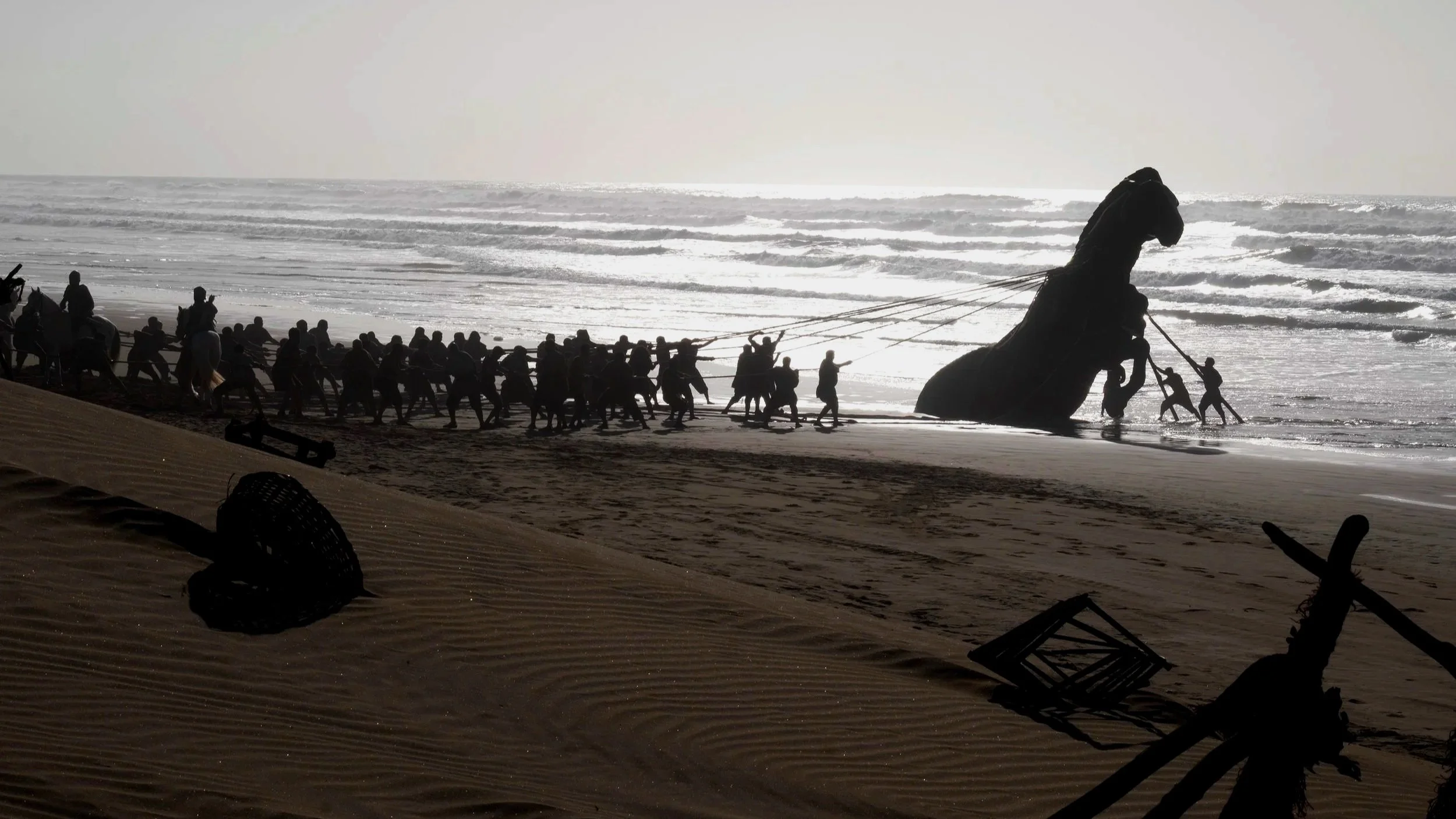
Carrying the Trojan horse | Still courtesy of Universal Pictures

In what feels like a fitting continuation of Oppenheimer and, within the broader arc of his career, another natural progression, Nolan once again turns to time, the defining preoccupation of his cinema. Faced with adapting one of the foundational and oldest works of Western literature, the blockbuster auteur behind Interstellar, Inception, and The Dark Knight willingly positions himself beneath the immense cultural weight of its legacy.
Mostly informed by Emily Wilson's acclaimed translation of The Odyssey — itself the subject of considerable debate for its contemporary and colloquial language — Nolan's interpretation was never going to escape similar scrutiny. Every adaptation of Homer inevitably enters into conversation with centuries of competing ideas about authenticity and fidelity, and Nolan approaches that inheritance with an unusual balance of reverence and confidence, refusing to treat the epic as either an untouchable monument or a text to be wholly dismantled.
That said, I personally would have preferred a different title to better signal that this is not a one-to-one adaptation. It is undeniably a reinterpretation, one that engages with Homer's text as a revisionist deconstruction and a deeply personal artistic statement rather than a straightforward retelling. A new title might have better prepared general audiences for a film less interested in reproducing the epic than in examining and reimagining it. It also could have afforded the film greater freedom to depart from its source without inviting expectations of referential accuracy. Still, I admire the conviction behind the decision. It is both a bold creative and marketing choice, one that embraces the inescapable dialogue with Homer's legacy rather than attempting to disguise or distance itself from it.
If the literary burden were not enough, Nolan also assumes a technical one. The Odyssey is the first feature film shot entirely on IMAX, an achievement whose sheer scale might have encouraged the kind of formal excess often associated with his earlier work. Instead, the technology becomes remarkably restrained. That restraint is all the more impressive given the unwieldy nature of the IMAX camera, whose refrigerator-sized body imposes fairly practical limitations on movement and staging.
But through Dutch-Swedish cinematographer Hoyte van Hoytema's photography and the crew's inventive craftsmanship — including a blimping system and a custom mirror rig that expands the camera's expressive possibilities — those constraints are mitigated to great effect, producing images of extraordinary clarity, contrast, and intimacy without ever calling attention to the machinery behind them. Even so, I found myself wishing for greater visual variety in the design of each location, as many of the islands gradually lose their distinct identities, feeling less like self-contained destinations than successive stops along the sea. Likewise, as in much of Nolan's filmography, the action sequences remain more plainly functional than genuinely exciting. With the added challenges introduced by the IMAX camera, the result is, by this point, regrettably predictable.
With all things considered, the vast landscapes and unflinching close-ups never exist for grandeur alone but to serve the film's emotional ambitions and otherworldly dimensions. Rather than enlarging the legend through spectacle alone, Nolan consistently lowers his gaze toward the man beneath it, allowing the scale of the filmmaking to bring into sharp focus the vulnerability instead of glorified heroism without sacrificing worldbuilding.
That holistic perspective fundamentally defines not only how the film feels and looks but also how it tries to dissect its hero and the world he inhabits.
After the triumph of Troy, Odysseus (Matt Damon) discovers that a man's fragile understanding of honor is betrayed less by victory than by the price it demands and even more so by the shame that lodges itself within its consequences. That festering wound is seeded by his violation of xenia, Zeus' sacred code of hospitality, when he exploits the Trojan Horse, transforming a sacred offering into an instrument of deceit. It is this very transgression that also betrays his men: in his desperate attempt to preserve his pride during battle, he makes a fateful decision that leads to the destruction of two of his ships. It takes only a single glance from Eurylochus (Himesh Patel), one of his most trusted companions, to cast doubt on Odysseus' judgment.
The supposed success that should have secured his legacy instead condemns him to a prolonged reckoning. Stranded on Calypso's (Charlize Theron) secluded island, Odysseus finds himself trapped in a limbo with a goddess who feeds him lotus as he comes to terms with whether remembering, despite offering little happiness, possesses the grace to recover what was real. It is only when Athena (Zendaya) intervenes, urging him to return to Ithaca, that his long return finally begins, not as a victorious king's homecoming but as an aching confrontation with the repercussions of his own choices.
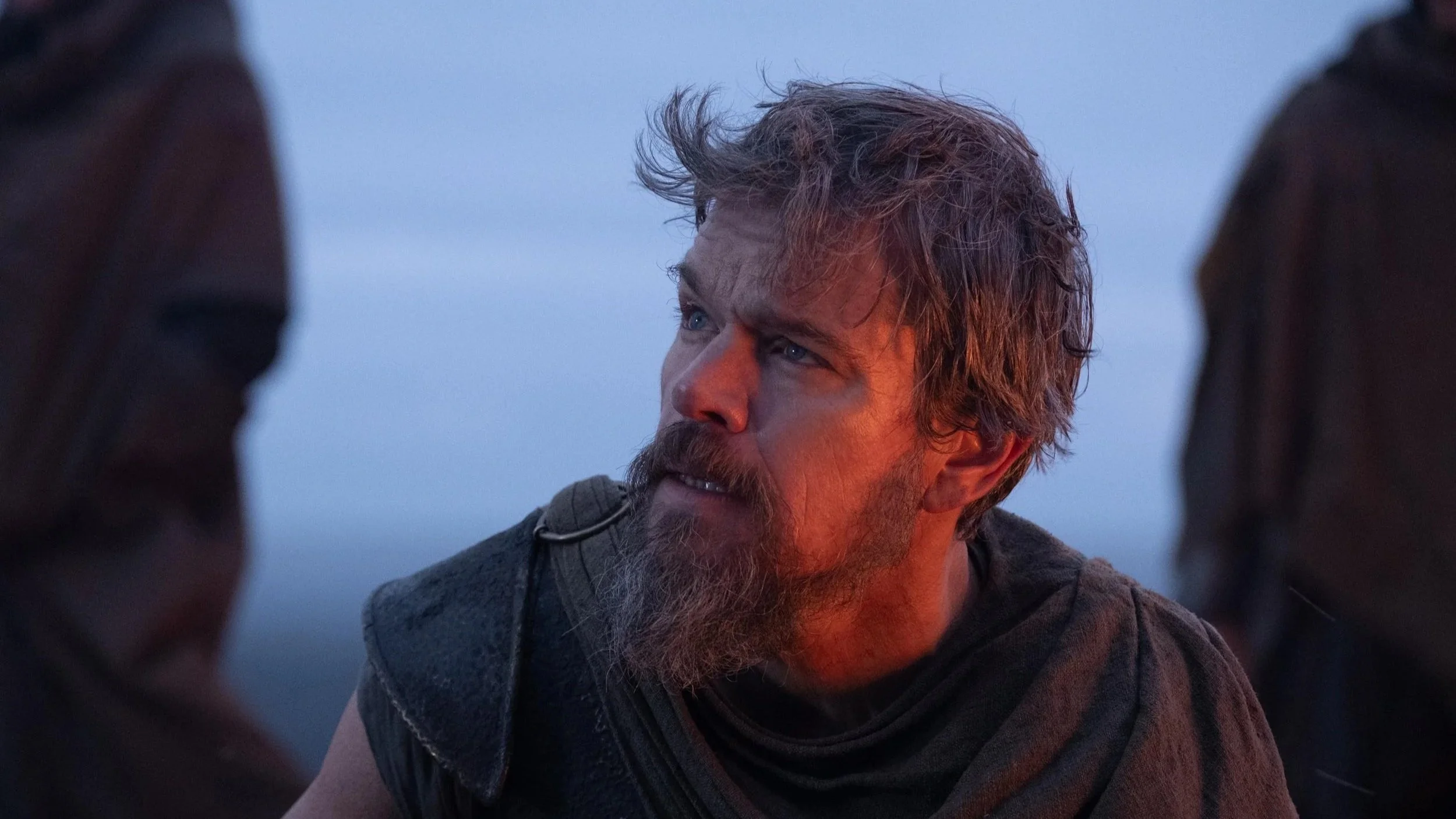
Matt Damon as Odysseus | Still courtesy of Universal Pictures
The ruse at the root of this predicament secures victory for King Agamemnon (Benny Safdie) and the Greek army, but it cannot absolve either him or Odysseus of the arrogance and moral debt that made such a triumph possible. For Nolan, however, victory is merely the axis of discussion. He poses a more unsettling question: was any of it truly worth it? Was it Helen's (Lupita Nyong'o) face that launched a thousand ships or the vanity and petty ambitions of kings that condemned thousands to die? And if even the gods cannot save men from themselves, what, ultimately, was any of it for?
Agamemnon's fate offers one answer. He returns home only to be murdered by his wife, Clytemnestra (Lupita Nyong'o), whose vengeance stems from his sacrifice of their daughter, Iphigenia. The war may be over, but peace remains elusive. If sacrifice commands fate and omens merely bear witness to it, where does the promise of a peaceful home find its place? By extension, Nolan carries this inquiry beyond the battlefield, revealing another family undone by the dogged pursuit of glory. Though born of different circumstances, the tragedy is no less devastating.
Glory, Nolan suggests, is a gilded burden that eventually outlasts the moment of conquest. It affects lives, destroys families, and leaves no one untouched by the weight of the choices made in its pursuit. What follows, then, is not a celebratory voyage home but a years-long crisis of conscience, as every trial and misadventure becomes another reminder of the debt Odysseus incurred at Troy.
The gravity of that realization is not his alone. It reaches his ever-loyal wife, Penelope (Anne Hathaway), who endures the grief of not knowing whether he will ever return while fending off the relentless advances of shameless suitors led by the charismatic Antinous (Robert Pattinson), who remains indifferent to the fate of Sinon (Elliot Page), the man who took his place in the military draft, and perhaps also harbors affections for Melantho (Mia Goth), one of the queen's attendants.
It also falls upon Telemachus (Tom Holland), whose passage into adulthood is tempered by a father he scarcely knows and by the impossible task of preserving his family's dignity in Ithaca. Menelaus (Jon Bernthal), the brother of Agamemnon, offers what guidance he can, but it is his gritty firsthand account of the Trojan War that gives Telemachus his first real glimpse of the man his father truly was. In Odysseus' absence, the kingdom itself begins to buckle under the weight of instability. But the loyal swineherd Eumaeus (John Leguizamo) clings, however tenuously, to the hope that his rightful king will one day return to a household, a people, and even a faithful dog that has never stopped waiting.
These characters wouldn't thrive without the performances and the screenplay's structural choices that allow them to breathe. The latter is especially surprising given The Odyssey's predictably Nolan-esque nonlinear structure, a recurring point of contention in his previous works, which have often become mired in dense exposition. Despite its fragmented design, the story never loses sight of its characters, allowing every emotional beat to land while an ensemble grants those moments with tangible emotional urgency. Of course, none of this would feel as cohesive without the touch of his longtime collaborator, editor Jennifer Lame, whose propulsive craftsmanship comes as no surprise given the consistency of her work throughout her career. Even so, the film's opening stretch could have been more economical, with a few pockets that only fully reveal their purpose on a rewatch, making their initial pacing feel more cumbersome than it needs to.
Among the standouts, Matt Damon delivers a weary, deeply self-reflective Odysseus, arguably one of the finest performances of his career. I was deeply invested in his portrayal, as every flicker of doubt and resolve registered across his face. He delivers a monologue so ruptured with vulnerability that it strips away the pedestal surrounding the mythological figure. Robert Pattinson, as usual (yes), brings a persuasive tenacity to Antinous, making the character's manipulative charm as alluring as it is threatening. Whenever he appears on screen, I find myself instinctively rooting for him, even when I knew I shouldn't. His small behavioral tics make him engaging to watch. That ending sequence that involved him, to say the least, left me grinning so hard. Tom Holland's performance isn't without its awkward moments, specifically in his exchanges with Antinous, but they hardly diminish the overall experience.
The supporting cast largely gets the job done, though some performances struggle to leave a lasting impression due to their limited screen time, particularly Lupita Nyong'o’s Helen, Zendaya's Athena and Charlize Theron's Calypso. Their relative absence nevertheless feels deliberate as they function as extensions of Odysseus' fractured psyche and embody the guilt and shame that continue to haunt him. The exception is Helen. Her role feels noticeably underdeveloped, which is a shame given that she is the impetus for the Trojan War. A more pronounced presence could have better reinforced the conflict that sets the entire story in motion.
Athena, however, proves especially compelling in the film's closing movements, where her role circles back to the atrocities committed at Troy and recontextualizes the journey that preceded it. While Nolan's writing still bears moments of inelegance, this thematic payoff is among the strongest and most realized of his career.
Anne Hathaway's Penelope, meanwhile, crops up as one of my biggest surprises, afforded far greater dimensionality and portrayed with an operatic disdain for the hubris that fuels these men's ambitions. Nolan's treatment of a character comparatively underdeveloped in the original text is a welcome revision (not just to the text but to his dead wife syndrome). It transforms Penelope into one of the film's emotional anchors and one of the most intriguing reinterpretations of Homer's epic. It also speaks to a larger strength of the adaptation: its willingness to make fearless choices and commit to them wholeheartedly.
The story makes numerous departures from Homer's text, some to its benefit and others to its detriment. Nolan relocates the epic's central moral inquiry while repositioning familiar characters with new motivations and emotional textures. These alterations and omissions occasionally deepen the drama and tighten the experience, but elsewhere they invite scrutiny, not because they depart from Homer, but because they are not always executed with the same conviction as the film's strongest revisions. Several themes and interpersonal dynamics are left unexplored, including facets of Odysseus' character that might have yielded a richer engagement with the source material. But pursuing them would likely have diluted the singularity of Nolan's vision. It is the inherent trade-off of his reinterpretation: narrative breadth is relinquished in favour of a more concentrated statement about what The Odyssey ultimately means to him.
But still, the auteur approaches both this world and its legendary hero from a humbling vantage point, reshaping the epic through a contemporary moral lens without losing sight of its essence. Rather than mythologizing Odysseus from afar, he remains faithful to the spirit of the poem while deconstructing one of Western literature's most enduring heroes. The way it exposes the fragile humanity buried beneath centuries of heroic idealization is tastefully executed. In doing so, The Odyssey becomes more than an attempt of retelling an ancient text. It stands as an interrogation of the values those myths have long upheld and of what they continue to reveal about the civilizations that inherit them.
That same philosophy extends to the world Nolan constructs. Giants and whirlpools emerge from landscapes that are at once unmistakably mystical and placeless. His vision of The Odyssey is more grounded than its source material, foregrounding natural calamities as manifestations of divine intervention rather than depending on overt displays of supernatural spectacle. It is not just a fitting vision to carry the description of the gods as being deathless, but as something more spiritual and omnipresent. Poseidon, Hermes, and Zeus remain unseen throughout, but their absence paradoxically makes them feel more omnipresent. Through constant invocation and the characters' reverence, the gods become invisible forces that govern every omen and every triumph.
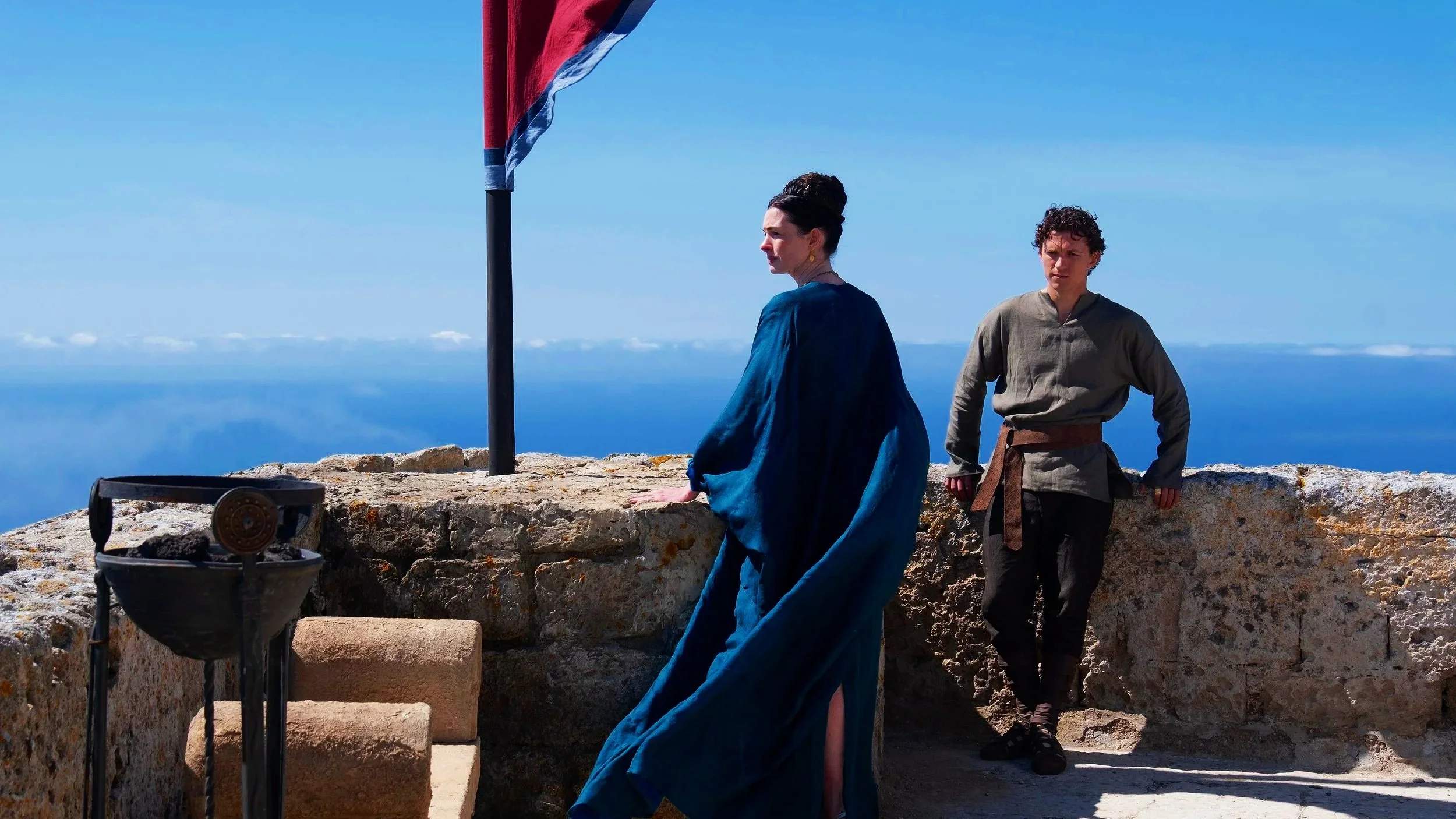
Anne Hathaway as Queen Penelope and Tom Holland as Telemachus | Still courtesy of Universal Pictures
Even the mythical creatures possess an unexpected physicality. The Cyclops (Polyphemus), in particular, is rendered with a tactile, lived-in presence that feels entirely in keeping with Nolan's sensibilities. The encounter is startlingly tangible rather than digitally manufactured, giving it an unnerving quality that does justice to Goya's Saturn, which was an inspiration. The same can be said of Samantha Morton's Circe, whose hypnotic presence is matched only by the boiling rage coursing through her performance. The result is a sequence with an embodied eeriness that reaffirms the film's central concern with man’s appetites, primal urges, and the ruin they breed. The depiction of the Underworld is one I was equally taken by. Its imagery and soundscape are so perfectly in sync with the specific narrative beat that the suffusive mood never loses its hold. If anything, these moments serve as a tantalizing glimpse of what Nolan might accomplish were he to fully embrace the horror genre.
Elevating these set pieces is Ludwig Göransson's score, continuing the remarkable creative streak he has built across Nolan's films since Tenet. Blending traditional Greek instrumentation with gongs, scrap metal, and driving vocal chorales, the soundtrack organically bridges the ancient and the contemporary. If the film's locations occasionally suffer from a lack of visual diversity, Göransson's score fills that gap, endowing each sequence with its own momentum. The sirens sequence is a perfect example: despite its brevity, it leaves a powerful aftereffect through its sensorial sound design. At its best, the score synchronizes seamlessly with the film's visual rhythms, heightening moments of tension and wonder without ever being overbearing.
The compounding result is a mythological world that feels both ancient and immediate, preserving the epic's sense of wonder without sacrificing its humanity. Its finale arrives as one of the most rewarding thematic and emotional payoffs of Nolan's career, finding the filmmaker finally making room for a resolution that is patient rather than hurried, while accommodating the myths he has spent a career constructing by revealing himself at his most personal as a director and father who surrenders certainty in favor of faith.
For a filmmaker so often defined by scale and complexity, it is refreshing that Nolan's greatest achievement here emerges on a deeply personal level. Rather than treating Homer as an opportunity for imposing spectacle, he continually redirects the audience's attention toward the people beneath the myth, bringing their insecurities, compromises, and moral contradictions into sharper relief. It is a perspective that feels both modern and intimate, one earned through decades of filmmaking invested in flawed individuals and the consequences of their ambitions. In that sense, The Odyssey doubles as a reappraisal of the artistic impulses that have long defined Nolan's career.
With all its monumental scale and technical sheen, The Odyssey is essentially one of Nolan's most human blockbusters, if not one of his very best. That it balances these two achievements so naturally is a tremendous feat in itself. It is both a daring reinterpretation of Homer's age-defying poem and a wondrous culmination of the filmmaker's artistic evolution. By choosing to see the man before the myth, Nolan also turns inward, asking why these stories have endured across centuries: not because they elevate heroes into legends, but because they preserve the frailties and longings that make them recognizably human.
‘The Odyssey’ is now showing in Philippine cinemas.