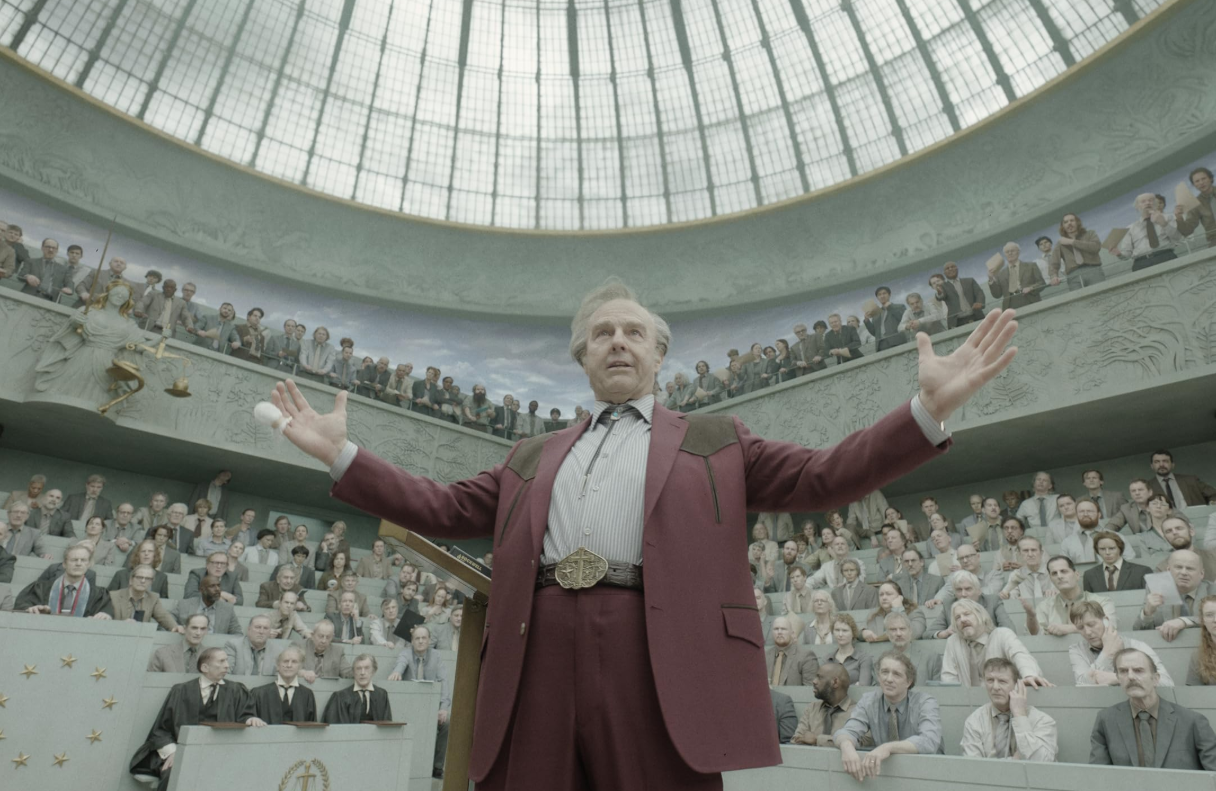

‘The Social Reckoning’ REVIEW: An Investigation Without Reckoning


Mikey Madison as Frances Haugen and Betty Gilpin as her lawyer / Photo courtesy of Columbia Pictures

There’s a peculiar kind of exhaustion that comes with watching another story about corporate misconduct, especially when the wrongdoing has already become part of everyday life. Public outrage has a remarkably short lifespan, while the institutions responsible often possess enough money and influence to outlast it. Facebook's history makes this particularly difficult to ignore.
Years of controversy have exposed how its platforms can amplify misinformation, exploit personal data, and contribute to political polarization, yet the company remains deeply embedded in the way people communicate. Aaron Sorkin's The Social Reckoning arrives at a moment when the public hardly needs convincing that something has gone terribly wrong. What requires greater examination is why knowing about these problems has done so little to resolve them.
Following whistleblower Frances Haugen (Mikey Madison) and The Wall Street Journal reporter Jeff Horwitz (Jeremy Allen White), the film dramatizes the investigation behind the Facebook Files, a collection of internal documents that revealed the company's awareness of harmful practices within its platforms. Sorkin approaches the material with his characteristic confidence in dialogue, constructing a narrative in which information gradually becomes evidence and evidence becomes a matter of public concern.
His fascination with people who believe in the responsibilities of their professions remains compelling, particularly when those convictions come into conflict with powerful institutions. Yet the film seems more comfortable celebrating the process of uncovering wrongdoing than questioning the conditions that allowed it to persist.
There's an undeniable appeal to Sorkin's writing when his characters are allowed to challenge one another intellectually. His dialogue can make complicated information accessible without losing its dramatic potential, and occasional exchanges retain the wit that has defined much of his career. Unfortunately, The Social Reckoning often confuses the delivery of information with dramatic development. Conversations accumulate without substantially altering the emotional stakes, while characters frequently articulate ideas that the audience has already understood. Sorkin's direction rarely compensates for these limitations, relying heavily on conventional framing that leaves the film visually restrained.
The absence of David Fincher becomes especially apparent here, since The Social Network understood how to express the psychology of its characters through filmmaking rather than depending entirely on what they said. Sorkin has inherited the subject's complexity without finding an equally persuasive cinematic approach to it.
The characterization of Haugen presents another difficulty. Her decision to expose Facebook's internal practices involved considerable professional and personal risk, yet the screenplay gives surprisingly little attention to the intellectual and moral reasoning behind that choice. Madison's performance occasionally suggests a more complicated individual than the writing permits, but Haugen increasingly becomes a character whose significance depends on how others respond to her revelations.

Mikey Madison as Frances Haugen and Jeremy Allen White as Jeff Horwitz / Photo courtesy of Columbia Pictures
The film's attempts to introduce romantic tension between her and Horwitz feel especially unnecessary, distracting from a relationship whose professional implications are already interesting enough. There's something revealing about a screenplay that recognizes a woman's courage while struggling to imagine her beyond familiar dramatic conventions. Haugen deserved a characterization that took her convictions as seriously as the consequences of her actions.
More frustrating is the film's limited understanding of the political implications of its own subject. Facebook operates across national borders, and the consequences of its decisions cannot be adequately understood through American political events alone. Sorkin's emphasis on January 6 gives the narrative an identifiable destination, but this concentration also narrows the investigation's significance.
Issues surrounding the mental health of young users and the platform's role in enabling harmful activity receive insufficient consideration, despite their relevance to the company's broader responsibility. The film appears determined to establish a recognizable moment of moral failure when the more difficult subject concerns the everyday practices through which such failures become possible. Its political criticism consequently feels strangely contained, as though identifying a particularly disturbing outcome could adequately explain the institution that produced it.
Perhaps the film's most revealing limitation lies in Sorkin's enduring confidence that institutions can correct themselves once confronted with sufficiently compelling evidence. Journalism becomes the vehicle through which moral clarity is restored, and the publication of the Facebook Files is presented with a sense of accomplishment that the subsequent history struggles to support.
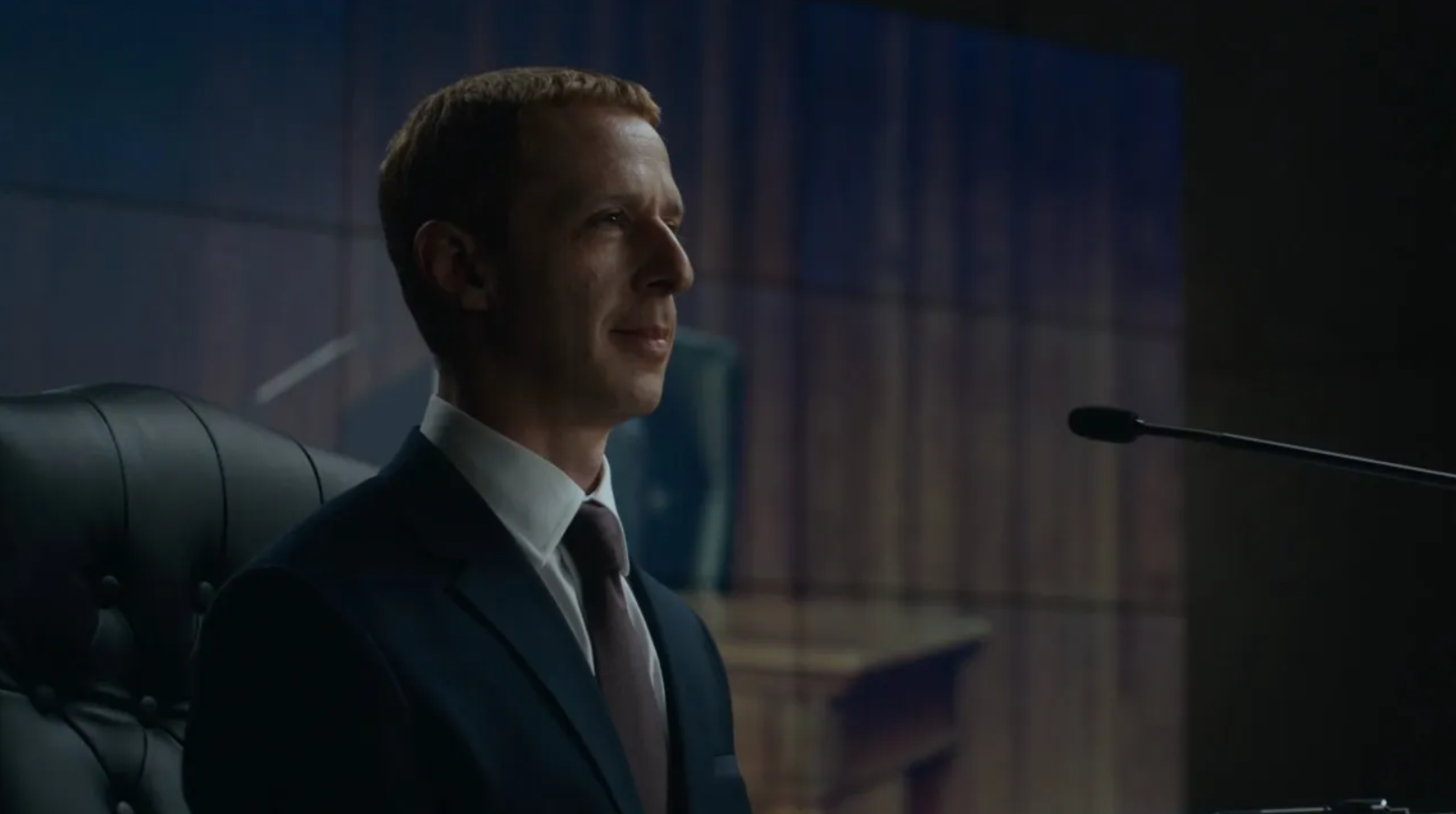
Jeremy Strong as Mark Zuckerberg / Photo courtesy of Columbia Pictures
Haugen and Horwitz's work deserves recognition, but the continued power of Meta complicates any suggestion that public disclosure amounted to meaningful institutional defeat. There's a difference between establishing what a corporation knew and possessing the political will to hold it accountable. Sorkin seems reluctant to examine that distinction because doing so would require a less reassuring understanding of the systems his characters hope to reform.
The result is a film whose intentions are considerably more persuasive than its conclusions. The Social Reckoning clearly wants to defend the importance of investigative journalism, and its commitment to that principle is understandable at a time when public trust in information remains deeply contested.
But the value of journalism shouldn't depend on the comforting expectation that exposing misconduct will eventually produce justice. Sometimes the most significant revelations are those that demonstrate how much an institution can admit, endure, and continue doing business anyway. A more searching film might have considered what accountability looks like when public knowledge has ceased to be an adequate source of pressure.
Sorkin remains an accomplished writer, but his attachment to moral resolution leaves The Social Reckoning curiously detached from the implications of its own story. The film recognizes the courage required to challenge a powerful corporation without fully confronting the limits of that courage in a system designed to protect corporate interests.
The film’s ending offers a satisfaction that history has yet to provide, and the distance between the two is impossible to overlook. There is genuine importance in what Haugen and Horwitz helped reveal, but honoring their work requires acknowledging how much remains unchanged. Perhaps that's the film's most disappointing irony: in trying to make a story about accountability feel complete, Sorkin ends up giving Facebook the one thing it hasn't earned — a conclusion.
‘The Social Reckoning’ is now showing in Philippine cinemas.