


‘Showgirls’ REVIEW: Divine Camp Takes the Limelight


Nomi Malone (Elizabeth Berkley) stripping at a rundown club / Still taken from NPR

TRIGGER WARNING: This review contains mention of rape
Once written off as an extravagant flop, the Paul Verhoeven-directed Showgirls has pushed its way back into the limelight as one of film’s bold camp classics. Its name now sits on the same things that once sank it: lines that swing from odd to grand, performances that stretch past drama into something strange, and a Las Vegas so bright and artificial it feels like a joke told with a straight face. Watching it again, I saw how the film’s stiff moments, rough charm, and feverish style work as the draw, not the problem. The film doesn’t aim to show camp from a distance. It leans into it, walks through it, and throws it at you with a kind of chaotic confidence that, somehow, has finally found the right crowd.
Showgirls follows Nomi Malone (Elizabeth Berkley), a drifter chasing a dream of making it as a successful dancer in Las Vegas. She starts out stripping in a rundown club, but her raw talent catches the eye of Cristal Connors (Gina Gershon), a headlining dancer. From there, Nomi gets dragged into the city’s harsh entertainment scene, where ego and rivalry sit in every corner. As she claws her way upward, each step comes with some new tilt in power, some trick, or some betrayal.
The film’s strength lies in how far it leans into absurdity. Once I saw Showgirls as camp, my experience with the film changed. When my partner and I rewatched it in theaters, he said I kept reading it through a modern lens, when the film wants you to sink into its absurdity. And I realized he wasn’t wrong. The film pushes its world so far, its lines, its drama, its neon heat, that the camp feels baked into every scene. The over-the-top edge feels intentional, and for me, it doesn’t just show Las Vegas. It moves with the same loud, glitter-soaked pulse the city wears like a badge. The sequins, the giant dance numbers, the slick sets, all of it shows how much of this world leans on illusion. But once the style settles, the film’s deeper intentions begin to blur.
I think Showgirls understands the world it wants to show, but the film never hits the point with the force it seems to build toward. I get the intention; this claim that the polished stage and the strip club run on the same logic, but the satire doesn’t fully work. It leans on excess to make its case and trusts the noise to do the work. It doesn’t, or not in a way that feels clear. The film keeps slipping into its own show, like it’s more focused on proving it can push boundaries than on shaping what that push should mean.
Even so, I see parts that feel true; how ambition bends people, how the system drains those without protection, how sex turns into a kind of tender that moves everything along, whether the room looks classy or not. But those parts drift inside a film that can’t hold its balance. I end up feeling that Showgirls aimed for something sharper but settled into something flatter, still reflective in places, but not enough to cut through the noise it creates.
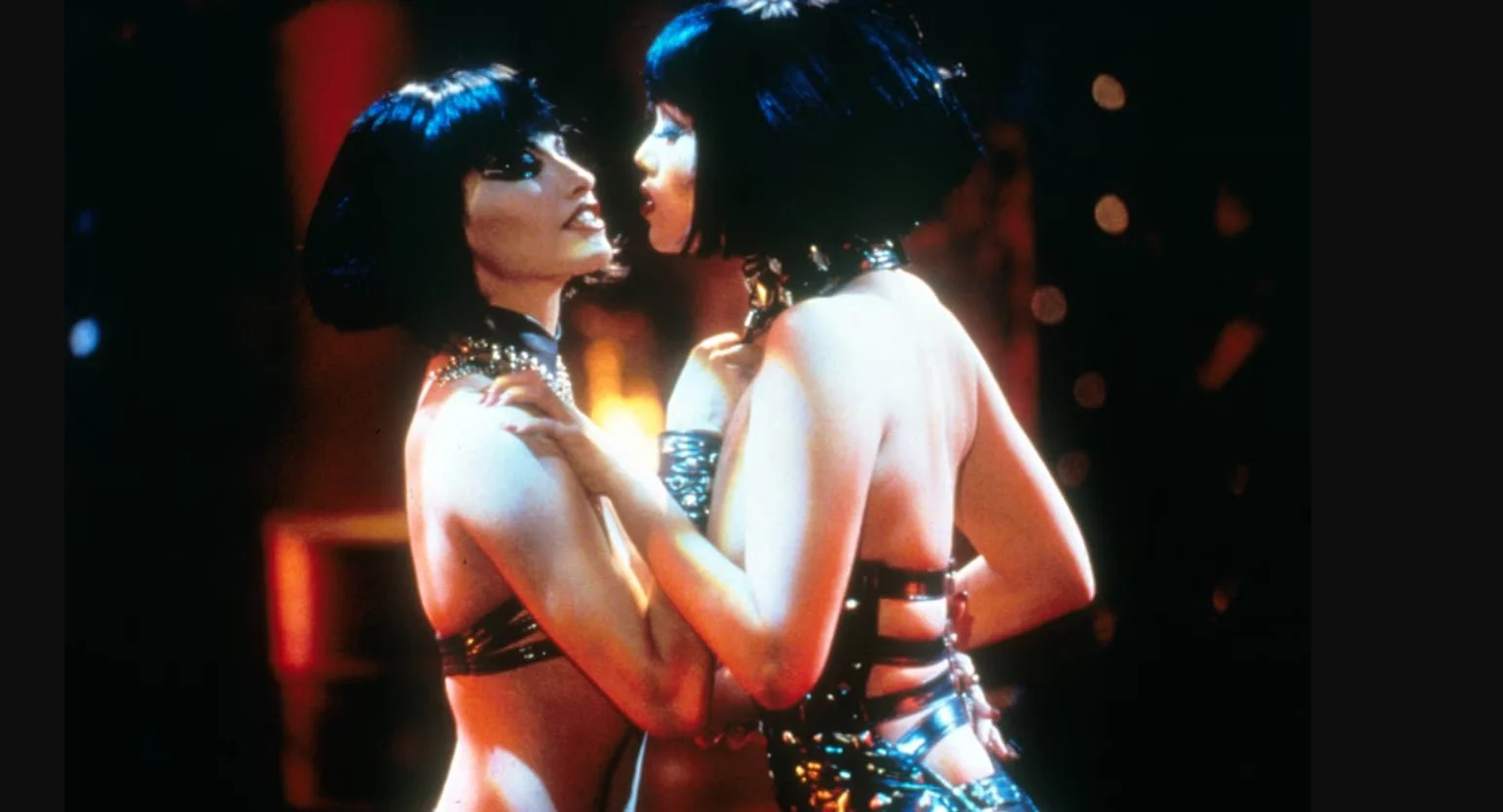
Cristal Connors (Gina Gershon) and Nomi Malone lock into an intense standoff during a performance / Still taken from E! News
Berkley reaches for heavy emotion and pulls Nomi’s anger and ambition into something solid, yet the film keeps drifting away from her, so she strains to stay grounded. Her force meets the film’s loud style, and the two push against each other, like she’s bracing herself just to hold her line. A looser tone might have let her breathe more and settle into the role. Gershon, on the other hand, moves with the film’s wild pulse as if it fits her skin. Her sly lines, crooked smile, and bold presence hook right into Verhoeven’s chaos, as though she knows the rhythm from the first beat. That ease sharpens her work and gives her scenes a clear snap, making her the film’s most magnetic pull.
The part that loses me sits in the film’s final act. Amid the film’s excess, Molly (Gina Ravera), who is Nomi’s closest friend and roommate, stands out for her sincerity; steady and free of the irony that fuels so much of Showgirls. She’s the character who most clearly deserves better, which makes the film’s turn with her all the more troubling. TRIGGER WARNING! The gang rape of Molly feels brutal in a way that exists only to force Nomi into a final narrative shift. It’s hard to watch not just because of the extreme and unnecessary violence but because it uses a Black supporting character’s trauma to drive the White lead’s arc. The scene slams the film out of its camp and into a grim, earnest tone, and the shift hits so hard that it breaks whatever satire the film had been trying to build. Both times I watched it, I enjoyed large parts of Showgirls, but that final stretch makes it hard to rate it any higher
Overall, Showgirls stays chaotic, loud, fascinating, and frustrating. Its camp is real, its aims sit in plain sight, and its execution and tone jump all over the place. But even with all its flaws, it remains as one of the most unforgettable films of its era, because nothing else looks or moves quite like it.
‘Showgirls’ is part of QCinema 2025’s lineup under the Rediscovery program.