

‘Wuthering Heights’ REVIEW: The Romance of Erosion

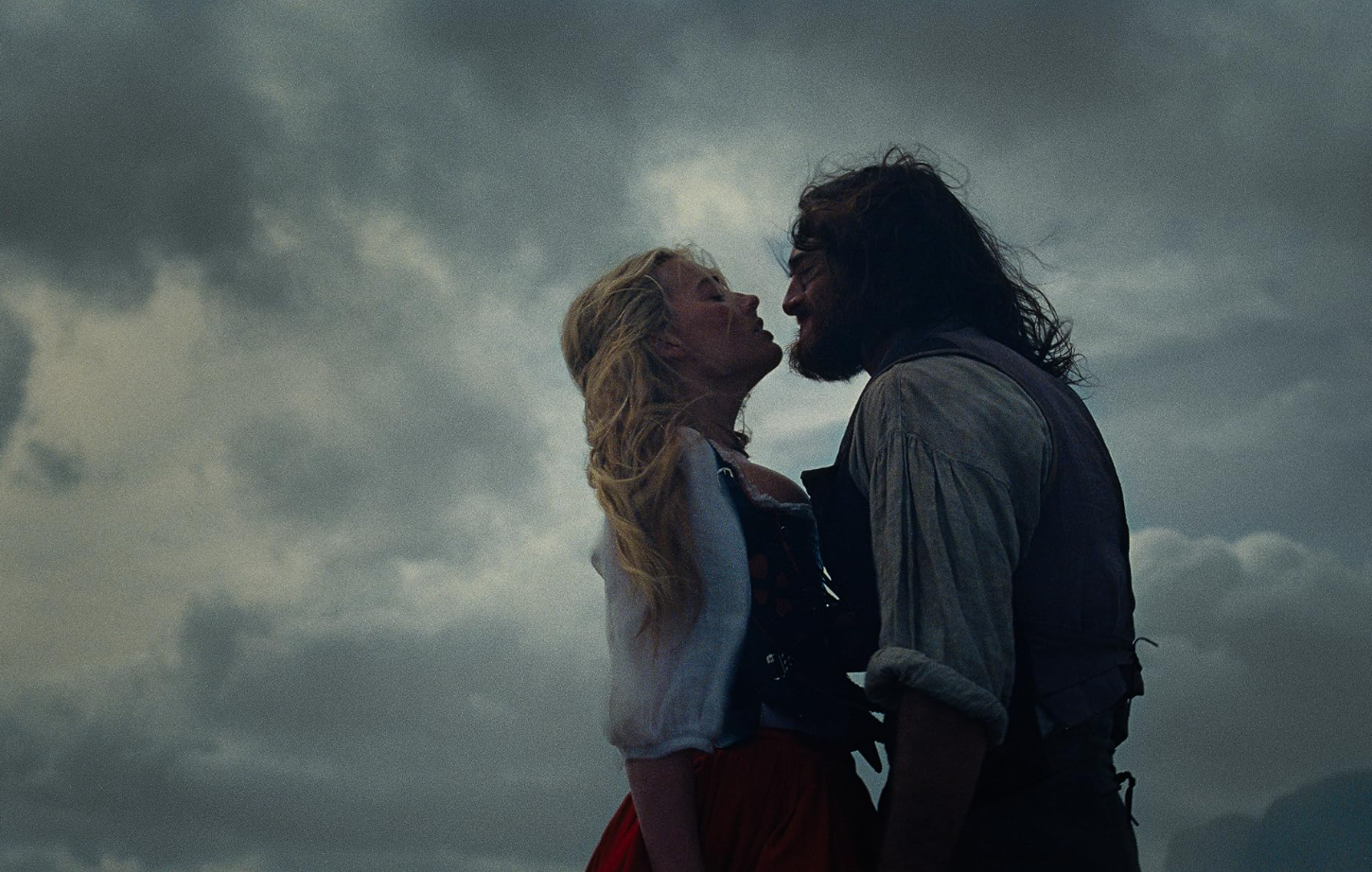
Margot Robbie as Catherine Earnshaw and Jacob Elordi as Heathcliff in ‘Wuthering Heights’ | Still courtesy of Warner Bros. Pictures

WARNING! SPOILERS AHEAD FOR ‘WUTHERING HEIGHTS’
Love is often described as steady, something that anchors rather than destabilizes. But what happens when love curdles into fixation, when devotion becomes indistinguishable from destruction? At what point does intensity stop being romantic and start becoming corrosive? That tension sits at the center of Emerald Fennell’s Wuthering Heights, a film that arrives already shadowed by debate. From the moment the trailer was released, discussion outpaced anticipation. The casting choices, the historical accuracy, the tone, everything signaled that this wouldn’t be a faithful adaptation of Emily Brontë’s 1847 novel.
A sweeping and turbulent tale of love and obsession, Wuthering Heights follows Catherine Earnshaw (Margot Robbie) and Heathcliff (Jacob Elordi) from childhood into adulthood. Set against the brooding, windswept Yorkshire moors, the film traces their passionate and often destructive bond, showing how desire, resentment, and social pressures shape their lives.
Wuthering Heights presents itself as a reinterpretation rather than a direct translation. Judged on those terms, it’s more watchable than early reactions suggested. Structurally, it stumbles. Thematically, it softens what was once jagged and confrontational. But it’s not careless. The story reshapes the novel’s generational fury into something sleeker and more accessible, framing love primarily as desire and obsession. In doing so, it strips away much of the social brutality that gave the original its weight. The result is a film that gestures toward emotional chaos without fully immersing itself in it. Passion is aestheticised rather than explored further, and that choice ultimately limits the tragedy.
In the novel, Heathcliff’s racial ambiguity isn’t an incidental detail. He is repeatedly described in ways that mark him as visibly other: dark-skinned, foreign, excluded from the rigid hierarchy surrounding him. That marginalization feeds his alienation and informs the bitterness that defines him. Removing that dimension does more than simplify characterization; it erases a layer of social hostility embedded in his trajectory. Film history offers a long pattern of smoothing over racial ambiguity in favor of whiteness, often under the justification of familiarity or marketability. The effect is rarely neutral. It reshapes power dynamics and blunts narratives rooted in exclusion. For a story so invested in displacement and inherited resentment, detaching Heathcliff from that context weakens the emotional architecture.
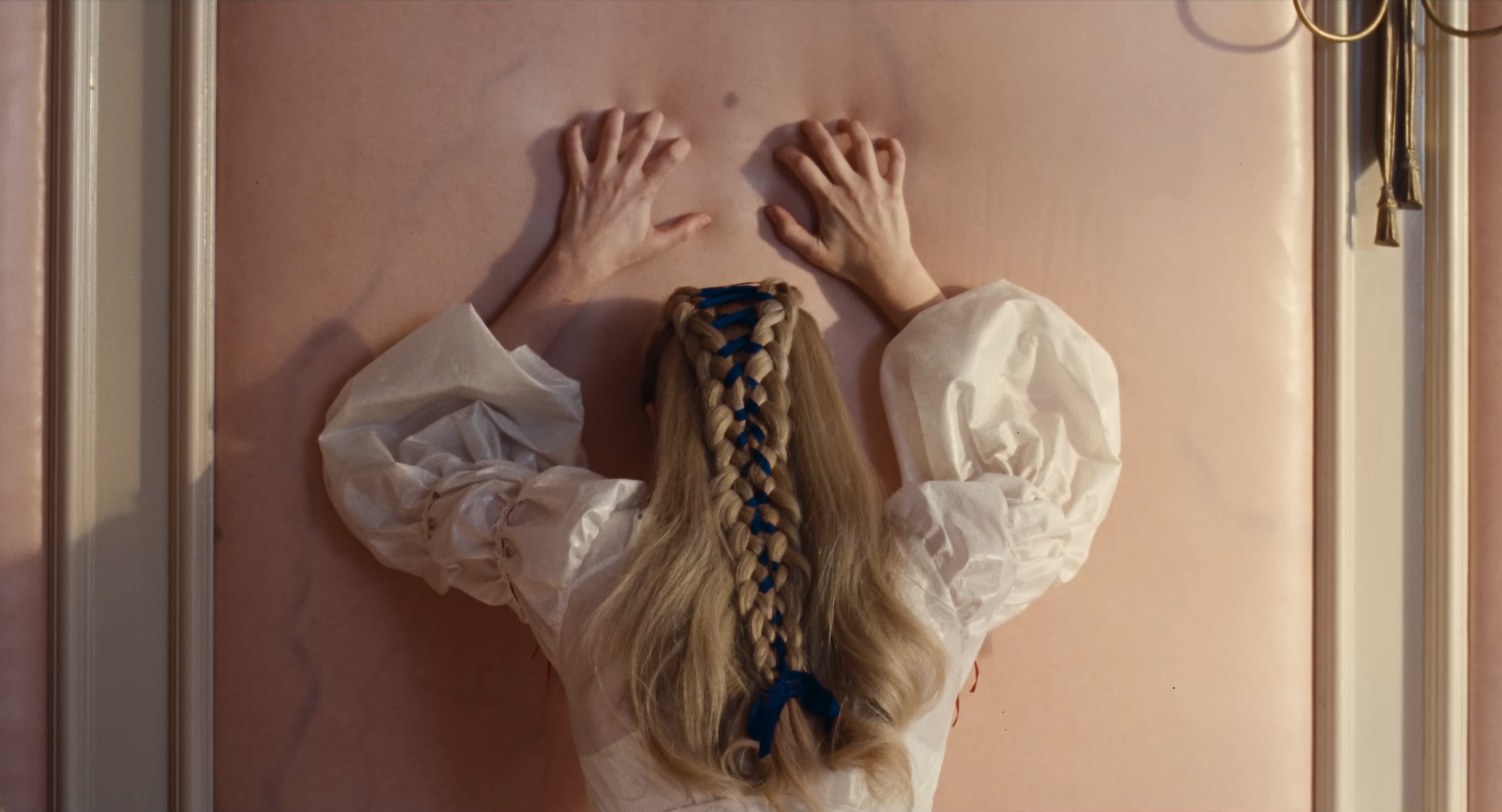
Catherine in ‘Wuthering Heights’ | Still courtesy of Warner Bros. Pictures
Where the film undeniably succeeds is in its visual language. Whatever reservations linger about Fennell’s narrative instincts, her control of composition is evident. The moors are rendered vast and oppressive, their muted palette and heavy skies creating a persistent sense of unease. The color grading leans into cold greens and grays without flattening the frame, allowing the landscape to feel both romantic and hostile. In sharp contrast, the Lintons’ residence is bathed in warmth and softness, almost dreamlike in its glow. It resembles a curated paradise, a fragile illusion of civility set against the rawness of the Heights.
Individual images stand out even when the screenplay falters. The death of Mr. Earnshaw (Martin Clunes), staged against a looming mountain of bottles, communicates decay and self-destruction with stark visual clarity. Catherine’s death is framed with a painterly delicacy. The film often speaks most clearly through these tableaux, suggesting a director deeply attuned to mood and atmosphere.
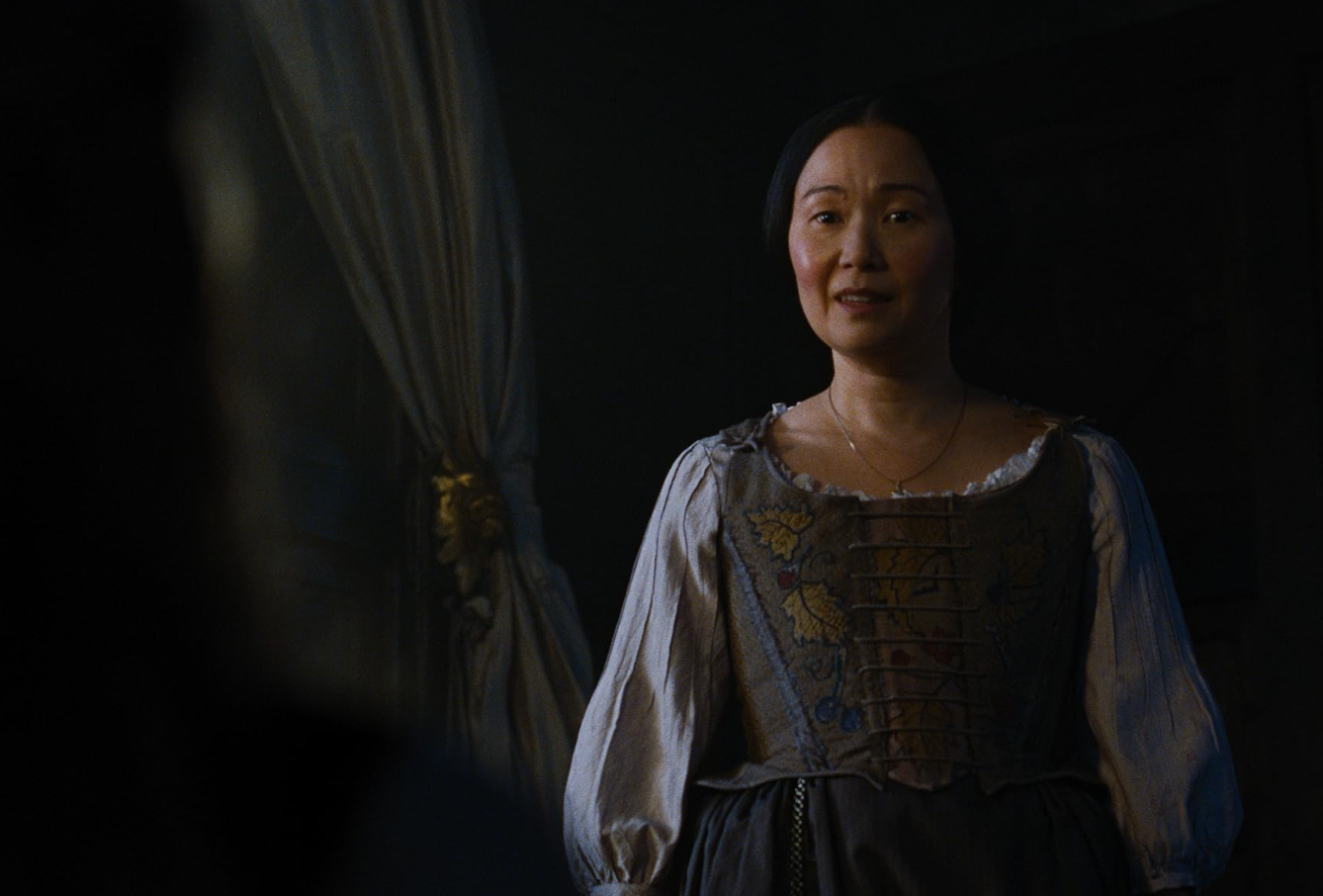
Hong Chau as Nelly in ‘Wuthering Heights’ | Still courtesy of Warner Bros. Pictures
One of the adaptation’s more thoughtful revisions lies in its treatment of Nelly (Hong Chau). In the novel, she primarily functions as a narrative intermediary, recounting events to Mr. Lockwood, a structural device common in nineteenth-century fiction. Here, she’s no longer confined to observation. She becomes an active participant, with motives and contradictions of her own. This Nelly is perceptive, occasionally manipulative, and emotionally entangled in ways that feel human rather than symbolic. There’s a current of resentment toward Catherine, shaped by years of unequal affection and social imbalance. Yet that resentment coexists with loyalty and sometimes care.
Nelly’s concern for Catherine never fully erodes, which complicates their dynamic in compelling ways. By granting Nelly interiority, the film introduces a grounded emotional perspective that the central romance sometimes lacks. She is neither pure witness nor villain, but someone shaped by proximity to obsession and its aftermath. In a story preoccupied with consuming love, giving depth to the character who endures its consequences adds a layer of humanity that the central relationship, in this adaptation, struggles to sustain.
However, one of the film’s biggest weaknesses is its hesitation to fully embrace its own provocations. Early moments suggest a psychosexual exploration of Catherine and Heathcliff’s bond, reinforced by imagery that leans toward the visceral and symbolic. From crushed eggs to intimate close-ups of organic textures, the visuals hint at appetite, transgression, and something feral beneath social restraint. Yet whenever the narrative approaches genuine danger or emotional rawness, it pulls back into safer territory. The relationship becomes suggestive rather than confrontational, leaving manipulation, power, and dependency largely underexplored.
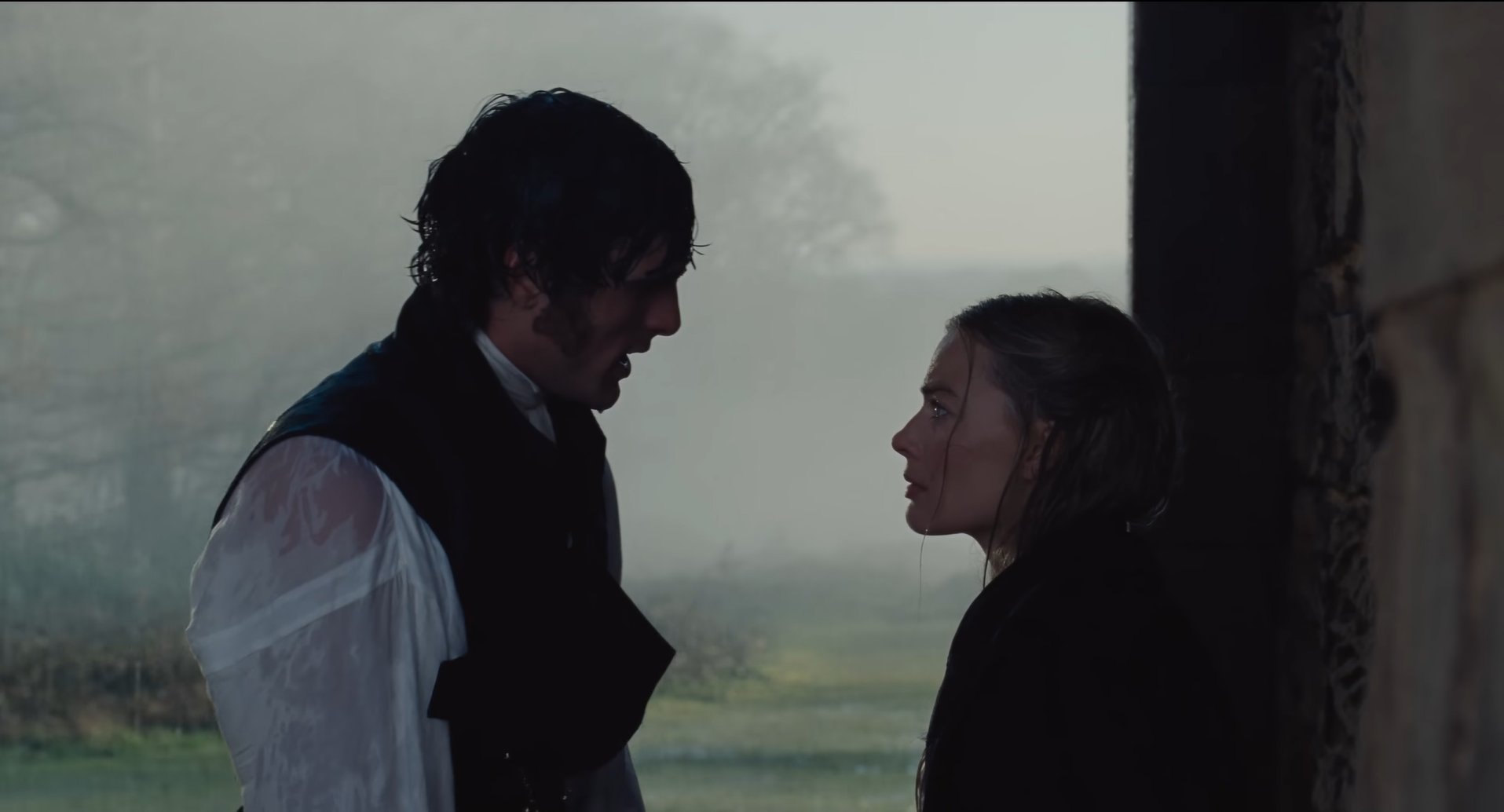
Heathcliff and Catherine in ‘Wuthering Heights’ | Still courtesy of Warner Bros. Pictures
Adaptation demands transformation. Literature and cinema operate through different tools; compression and reinterpretation are inevitable. A reimagining can work beautifully when it commits to its own vision. Amy Heckerling’s Clueless, for instance, borrows loosely from Jane Austen’s Emma yet stands confidently on its own. The difficulty here isn’t deviation but selectivity. As someone who has read the novel, I can say with certainty that this adaptation departs from the source more than it preserves. Had Fennell treated it as a loose reimagining with a different title, characters, or story, the choices might feel more forgivable; the audience could approach it on its own terms.
By claiming the lineage of the novel while selectively erasing its foundational conflicts, the film risks a tension between expectation and execution. It presents the surface of the source material, the brooding romance, the moors, the obsession, without fully engaging the depth of the world that made the original story unsettling and unforgettable. The result is a work that is visually and emotionally compelling in parts, yet structurally and thematically hesitant, caught between homage and reinvention.
Ultimately, Fennell’s Wuthering Heights is less a story of doomed lovers than an exploration of the corrosive nature of desire and obsession. While the film captures the intensity of Catherine and Heathcliff’s relationship, it softens much of the novel’s social and psychological complexity. Desire and romance here is not just passion but erosion, the slow unravelling of identity, morality, and selfhood under unrelenting longing. In this adaptation, the characters consume and diminish each other, mistaking intensity for inevitability, yet the adaptation hesitates to fully confront that destruction. What stays isn’t the romance itself, but the recognition that obsession can feel like destiny only because neither person knows how to exist without it, a tension the film gestures toward but never fully inhabits.
‘Wuthering Heights’ is currently showing in Philippine cinemas.