
‘Scarlet’ REVIEW: Life After Life
‘Scarlet’ REVIEW: Life After Life


Scarlet (Mana Ashida) set to make her journey in the Land of the Dead // Still from TMDB

Scarlet. The color of blood, the color of life, the color of burning passion, and could be the burning hue of revenge. It is also the name of Mamoru Hosoda’s latest film and its eponymous protagonist, the lead of a rather strange reconfiguring of William Shakespeare’s Hamlet.
The play, and by extension Shakespeare’s greater history and impact on theatre and drama as a whole, has been reconfigured, readapted, and recontextualized numerous times this decade alone, with Sam Crane and Pinny Grylls’ Grand Theft Hamlet virtual re-enactment and Chloe Zhao’s adaptation of Maggie O’Ferrell’s novel Hamnet making use of the story behind the drama for historical fiction.
Scarlet attempts to put a more fantastical, epic spin on the Shakespeare play, crafting a grandiose original world at the cost of anything interesting not only with the people who reside in it, but in anything beyond as its ambitions ultimately outpace its execution.
The story follows the beats of Hamlet in its initial first act retelling: a power-hungry royal, Claudius (Koji Yakusho) conspires with his wife to get rid of his brother in order to take the crown and title of king for himself, and successfully doing so through a frame-up, having him executed in front of his daughter Scarlet. Leaving her emotionally scarred and with images of his last words being obfuscated by the crowd, she spends the next decade planning her revenge against her cursed uncle, only to end up being poisoned beforehand to her imminent death.
Finding herself in the "Land of the Dead", mysterious world between life and total oblivion, Scarlet discovers that the man she aims to kill has followed her into this strange world to further monopolize his control, and in her despair and anguish, continues her quest beyond life. Here, she meets a young man from modern Japan whose memories are fuzzy prior to coming to this 'in-between place', and together they embark on a perilous journey to not only destroy the rot at the center of the kingdom, but to discover what defines them beyond the tale they are in.
Undoubtedly, there is indeed some potential in that initial setup through the hyperstylization of the vivid emotions of the original text through the lens of fantasy world-building, if it aimed to be a rather mostly straightforward retelling. Hell, the first couple of minutes where they re-stage the bones of Hamlet’s beginning with some interesting subtleties that could be rife with payoff is a rather engaging way of getting the audience in Scarlet’s headspace, making her quite likeable and sympathetic off the bat (which helps in allowing the audience to be gripped by the depths of her despair and emptiness).
When we do get into the ‘dead world’’, although the mechanics of how said world works are quite vague, the emotional component of how it encapsulates the purpose of one’s life beyond their death is a fascinating detail on its own, much more when it gets later recontextualized by a late-game twist.
Hosoda’s script packs in so much ambitions in his concepts to further amplify the sense of scale to a blockbuster degree, but ultimately, what sinks ‘Scarlet’ below the bar it eagerly sets itself up for is the lack of depth, nor coherence, in what its ambition is trying to convey even as it consistently adds more to its plate.
A sense of emotional distance develops within the character writing as the film goes along, which is a worrying thing when you bill yourself as a rip-roaring revenge tale, and the reliance on broad strokes, platitudinal writing derails any potential nuance to be found (there are more than one instance where a character just spouts out thematic exposition that directly asks the underlying question of the plot, which isn’t a death knell but it’s done so clumsily at times that it basically encapsulates the problem).

A look of uncertainty towards a strange companion // Still from TMDB
Scarlet and Hijiri’s central arc on the former’s cost of revenge against a corrupt kingdom reads as frustratingly moralistic and too linear for the extent of the themes in the story, which goes hand-in-hand with the reliance on platitude, but as the film progresses, the lens in which this plotpoint shifts towards a greater question: how much is a person defined by tragedy, and the era they are in?
It’s a loaded question, especially if we were to consider William Shakespeare’s oeuvre of tragedy plays beyond Hamlet and the greater historical and literary influences that have permeated and remained at their core. It’s an interesting discourse point to have at the center of the action, and if done with candidness and nuance, would bolster ‘Scarlet’ as a more reconfigurative genre work that reckons with the history of its source and where it originates, especially as the main twist that separates the story from ‘Hamlet’ makes itself apparent in the second act.
It’s a shame that it merely leaves all potential literary intrigue at the door for more high-concept emotional swings (one of which involves, and believe me when I say this, a set piece that shares an element with and pales in comparison to Sinners, you’ll know it when you see it) and straightforward moralizing. It’s not as if a whole deconstruction of history is needed in its entirety, but it’s frustrating to see a tantalizing question be posed only to not be followed up on in any meaningful way.
Now, is the spectacle good? Hosoda has always gotten plenty of mileage over his decades-long filmography for memorable, show-stopping sequences and imagery off of pure formal power alone, and ‘Scarlet’ definitely follows up on it to an extent. The use of a more computer generated, digital look within the ‘dead world’ adds both a level of weight and uncanniness that, in spite of its inconsistencies in look and rendering at times (as well as a heterogenous use of 2D in certain scenes), gives weight to character expressions and the action choreography when utilized well, shining through the moments of jank.
Some directorial and cinematography choices do provide the impactful image-making that is par for the course for Hosoda (especially in the third act boasting some impressively harrowing moments that have stuck with me after viewing), pushing through all of the film’s weaknesses with the equivalent of a bruised and frustrated yell that nevertheless still yields some sort of impact.
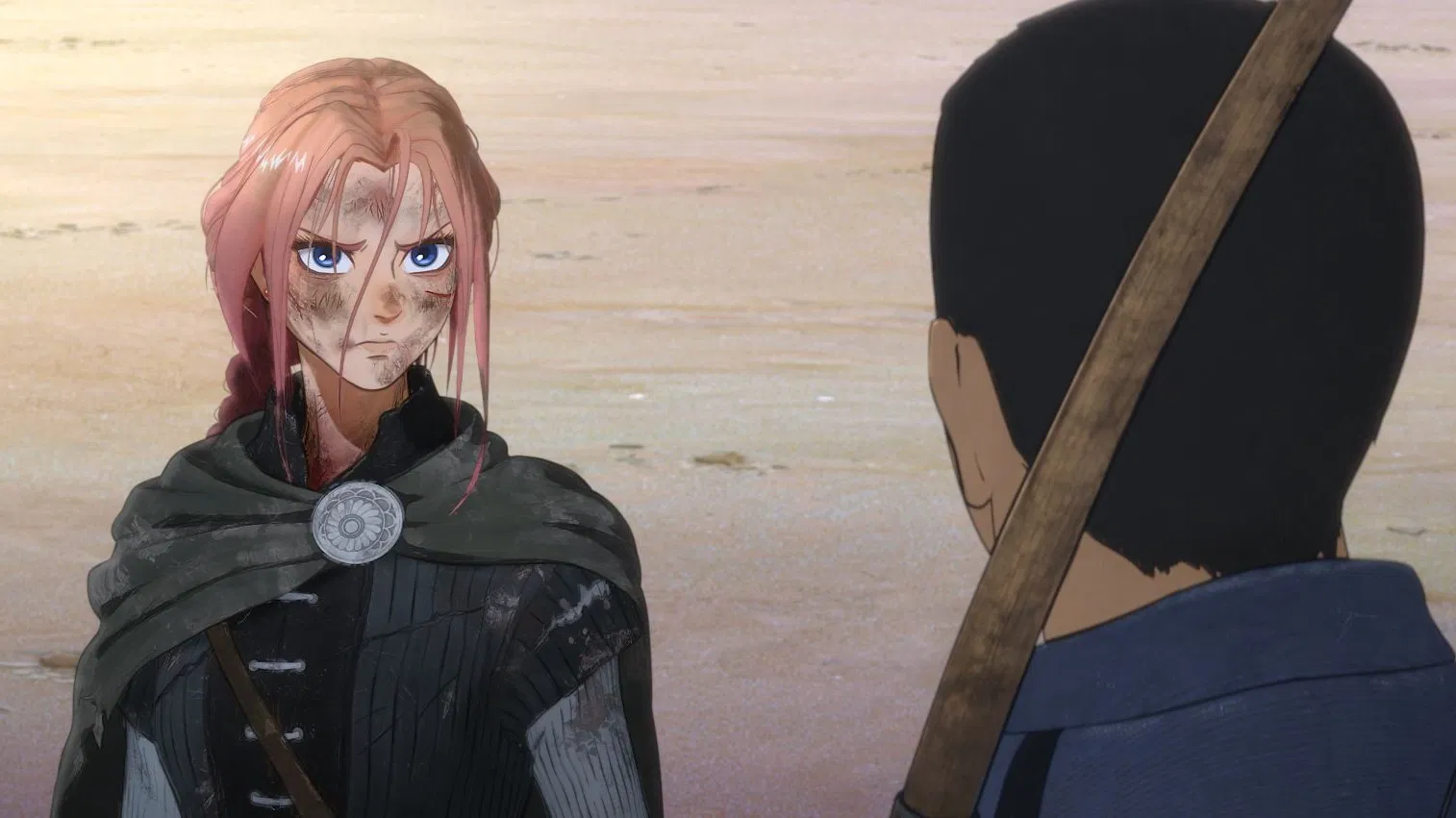
Scarlet (Mana Ashida) in a cryptic dream // Still from TMDB
Scarlet is an immensely volatile picture in more ways than one, settling for operatic bombast that it does somewhat well but still desiring to be a twisty moral reconstruction of the Shakespearean tale it builds off of, with only a slither of the finesse or introspection that it needed for the undertaking.
It’s unfortunate that late into his storied career, Mamoru Hosoda, who has proven in the past to be quite considerate in his reflections of family, technology, and history has helmed a feature that takes numerous easy ways out of the potentially interesting preoccupations it offers within the complexity of its characters, the nature of the world they reside in, and the nexus point of the very core of its plot. This all leads up to a narrative “full of sound and fury, signifying nothing”, invoking only a minimum of the catharsis that it should’ve had within.