
‘Manila’s Finest’ REVIEW: The Extent of Ideals
‘Manila’s Finest’ REVIEW: The Extent of Ideals


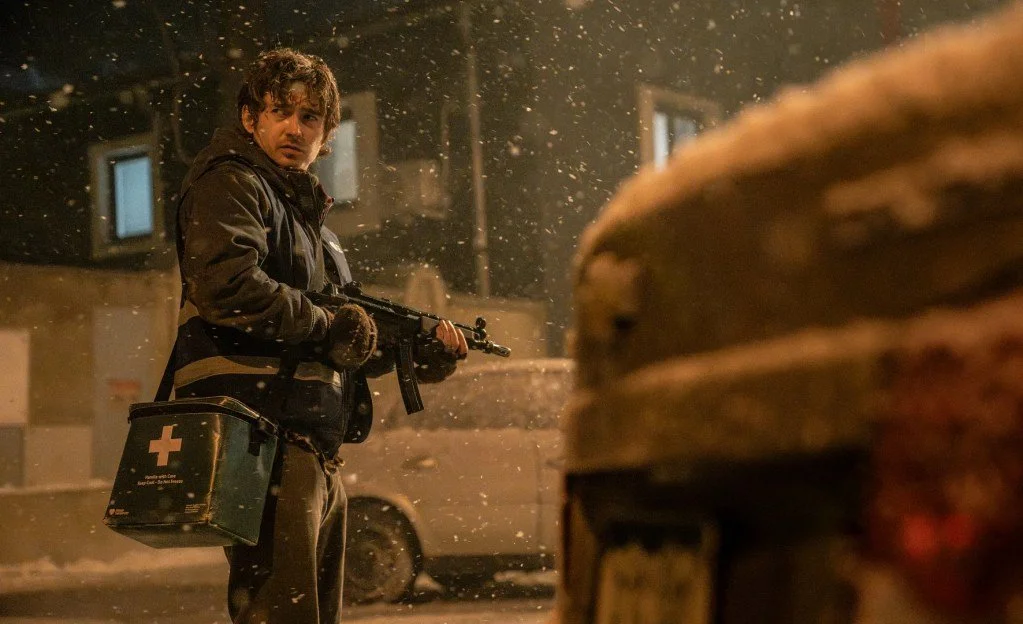
A group of policemen headed by Capt. Homer Magtibay (Piolo Pascual) on night patrol // Still from press kit

‘Manila’s Finest’ opens with a text overlaid on a dark background, claiming that the film is constructed based on memory, rather than history. Although this has been a common device used in past films to further set the scope the following film would sketch (a notable international usage would be in Alex Garland and Ray Mendoza’s Warfare), this warning would ultimately feel less like a disclaimer and more of an omen, that in spite of the levels of cognitive detachment us humans try to impose on ourselves, the personal is still deeply intertwined with the political. How the film would use this mulling, would form the backbone of one of the year’s most elusively sobering texts, one whose disparate threads would form an emotionally dense web of reckoning.
Initially set in the last year of the 1960’s, Manila’s Finest focuses on local policeman Capt. Homer Magtibay (Piolo Pascual), one of the members of the Manila Police Department who spend their days trying to keep the city peaceful, most commonly alongside headstrong partner Lt. Billy Ojeda (Enrique Gil) and confidant and chief Conrado Belarmino (Ariel Rivera).
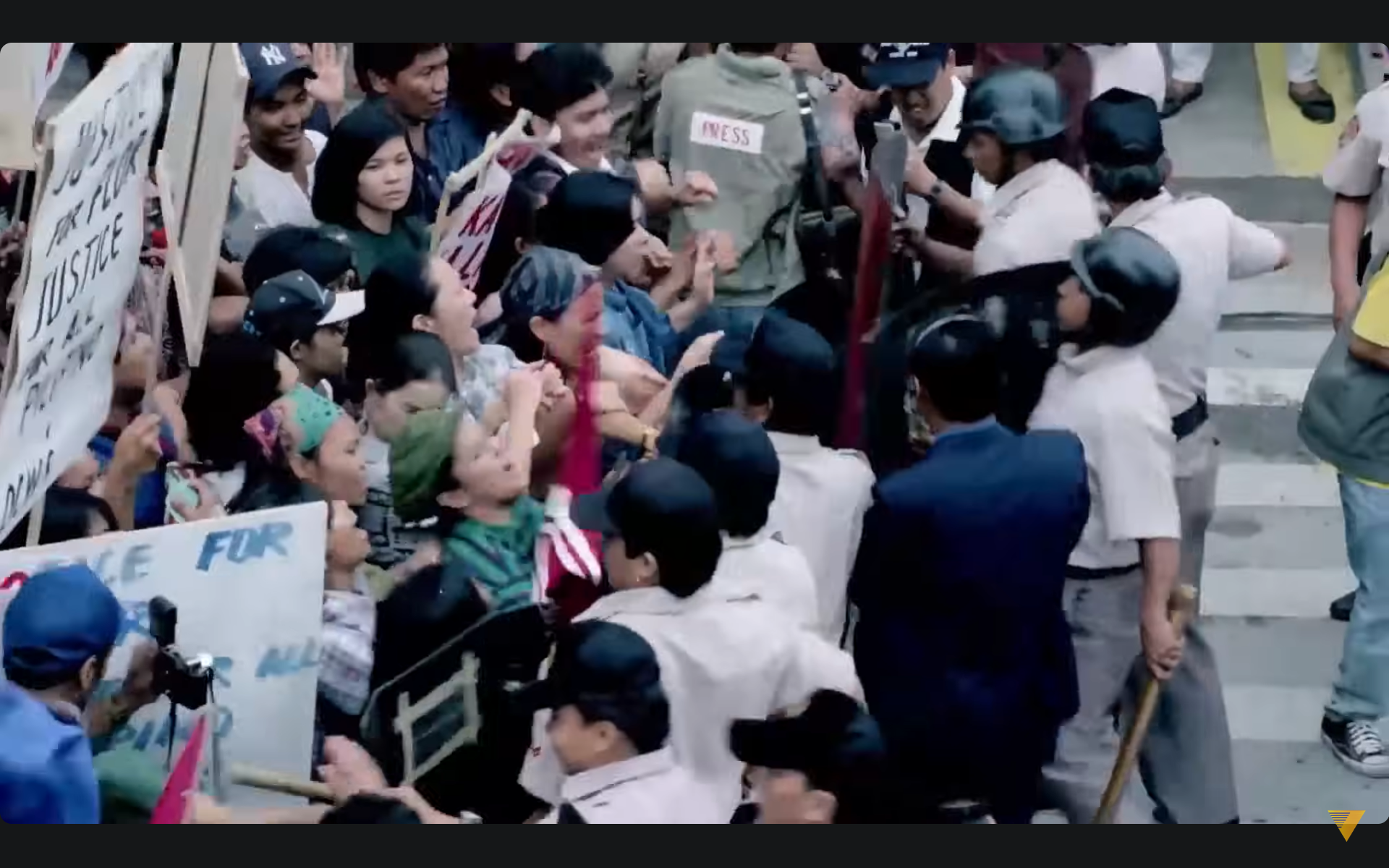
In the middle of a transitionary period within the country, a string of deaths connected to a local turf war grabs the attention of the eponymous Finest, but as they investigate what lies at the root of these incidents and trying to keep their moral compass at the same time, the department, and Magtibay himself, would be soon be shaken by the reality that the ideals that they serve may not be as pure, nor tangible as they seem, as the shadow of the government’s response to the nation’s First Quarter Storm looms over them.
Compared to what some might think judging from the marketing or the logline, Manila’s Finest isn’t exactly close to a traditional action genre picture with the expected standoffs and detective work that is more akin to other propulsive entries in this canon. Instead, the script (written by veteran writers Moira Lang, Michiko Yamamoto, and Sherad Sanchez) paces the film a slice-of-life, focusing on the interiority of Manila, the day-to-day execution of police work and the culture and ecosystem of the people living there. Although the perspective is locked mostly on Magtibay’s point-of-view, there are still enough nuances to capture a society beyond his zeroed-in perspective (which goes hand-in-hand with how the film does characterization, as I’ll mention later), making every scene feel alive.
A majority has to be owed to the general visual form of this film, helmed by veteran of underground Filipino cinema Raymond Red (who took over for his daughter Rae in the middle of production). The production design fully evokes the time period the film tries to capture with its distinct locale and sounds. The more subtle touches in the scope of its cinematography, as well as meaningful blocking, allow for an involving frame that both expands and overwhelms its central subjects as the story progresses.

Capt. Homer Magtibay (Piolo Pascual) with a look of doubt // Still from press kit
What all of the artistic flourishes are in service of, is some of the more incisive commentary on the fascism that the police force serves of a film in this caliber (particularly in the Metro Manila Film Festival), and not because it is precisely direct with its own incisiveness. Whether subconsciously or not, Manila’s Finest is aware of the contradictions that its center viewpoints come with, the dissonance between the heroism our focal characters try to practice and the reality of what said heroism really implies. The extent of the gradual spiral in which our characters try to comprehend the purity of their intent and the cost of following it for the ‘greater good’ is a central arc that the movie builds upon not as an immediate ratcheting of tension, but a gradual vise grip that tightens further the more the poison inherent to the undertaking could no longer be ignored. Some of the more horrifying scenes come from this dissonance in perspective, where infringement of human rights becomes nothing more than a background detail that the film reflexively uses as part of its own goal of brutal de-mythologization, a theme that permeates throughout.
There are certain limitations to this approach, particularly in conveying the eyes of people beyond the police force (including family members, student activists, members of the community) to fully encapsulate the political turbulence of the period the plot takes place in. In this case, it feels more like a feature than a bug, as per the opening spiel of the film based on personal recollection, and it is able to justify its darkness as the hollowness of the justice the eponymous Finest begins to show amidst political turmoil, but the vantage point of focusing on this transparently corrupt body rather than the individuals they have affected could be an understandable dealbreaker, especially when space for more intrapersonal exploration within other sectors could also be afforded when the film is so locked in to this singular POV and ideological breakdown in its near 2-hour runtime.
And that’s what Manila’s Finest ultimately boils down to in the end: a story of inevitable personal erosion in the face of a system that perpetuates oppression in the name of status quo, the true face of ‘keeping the peace’. Magtibay’s attempts to hold steadfast in what he views as the classical image of the heroic policeman — expressed by Piolo Pascual’s subtly devastating performance, in an ensemble of numerous others, where every small glance feels a step away from mental disassociation or breakdown — ultimately lead him down to further heartbreak and distance from his family and emotional state as empty days go past, a gut-punch deconstruction of the genre trope of the ‘one good apple’, showing that in the macro of it all, the system is too warped, too broken to allow for a ‘good cop’ to prevail as easily.
The underlying moral quandaries fueled by sheer callousness set up by the movie for its characters not only serve as agonizing (in its terrifying groundedness and palpability) shows of human frailty and evil, but also a searing indictment of the ever-tainted chains of command, where the shape of injustice comes in the form of missing turned over files and sudden requests of relinquishing rather than the snatches and scuffles one might assume.
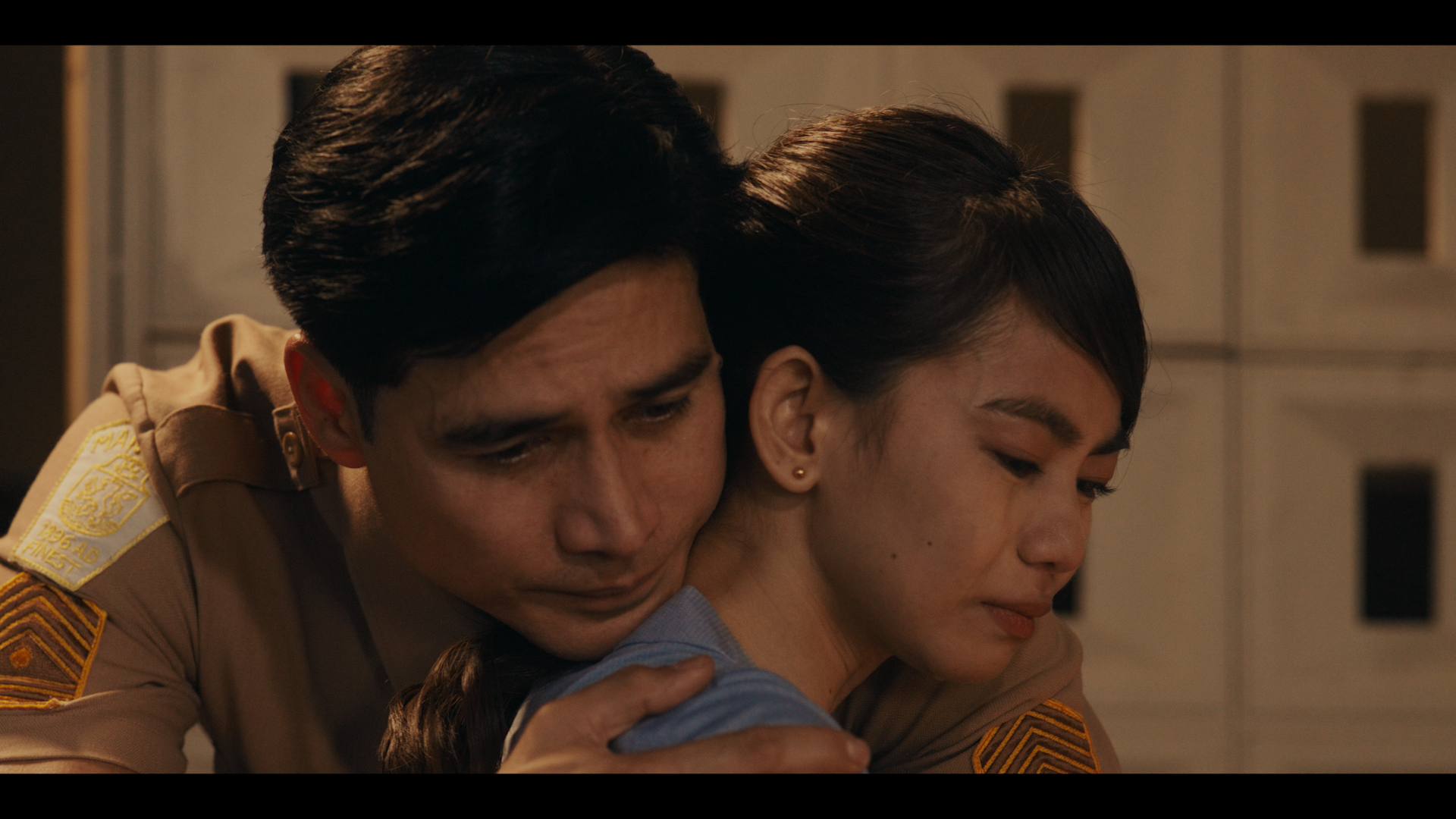
Capt. Homer Magtibay (Piolo Pascual) attempting to comfort his daughter (Ashtine Olviga) // Still from press kit
Manila’s Finest’s posturing of a distinct personal experience during a pivotal moment in Philippine history belies a more minutely bleak, complex narrative that actively pokes and prods at the nature of its viewpoint in conjunction with the overwhelming malfeasance it displays to the point of hollowing out the veil of its characters’ ideologies, and it is as much of a gradual gut-churner as it sounds. The tightrope it walks juggling its traditional plot elements to its more thorny subtleties does get a bit overwhelming when their multiple levels cross and intersect, the questions it poses striking a difficult balance between psychological astuteness and where its heart lies. When it is at its most effective, the film’s undercurrent of de-mythologization and suffocation by the throes of permeating, inevitable fascism provides a haunting tone that gives zero easy answers by the end. And with several things that have remained since then — the system of men in uniforms defending that same surname — why would it?