
‘Sana Sinabi Mo’ REVIEW: Love knows no time and distance

‘Sana Sinabi Mo’ REVIEW: Love knows no time and distance

This review contains spoilers.
The battle between love and religion can be compared to a game of tug-of-war. When two young people love genuinely, even time cannot stop them. When the other devotes himself wholeheartedly to his faith, every choice matters — a test between loyalty and desire will not be taken merely as a grain of salt.
Sana Sinabi Mo, a new Filipino drama film by Shaira Advincula, shares the same sentiment. It explores the journey of a young missionary named Seph, who plays Juan Karlos Labajo, as he uncovers his late father’s forbidden secret. Traveling from the Philippines to Spain, Seph searches every inch of the road, only to discover that his father’s past was not a simple act of young love.
Seph’s father, Otep (Bodjie Pascua as the present, JC Santos as the past), is more than a representation of what could have been. As he speaks through his letters, the film puts great emphasis on why his character matters, not just as a father to Seph, but also as someone who had loved the same gender. When loving the same gender is the greatest sin that one can commit, how did the film justify how one can still love from afar?

Seph (Juan Karlos Labajo) in Sana Sinabi Mo / Photo courtesy of Netflix

The silence that words hold
The film starts with Seph delivering his eulogy dedicated to his father. Before he ends, Cecil (Rosanna Roces as the present, Yesh Anne Bruce as the past), Otep’s best friend, causes a scene, revealing his true sexuality when he was young.
Seph, as the curious and loving man that he is, explored every corner to know the truth. The fact that his fathers kept secrets from him bothered him the most. It was not a simple reason of “he had a mistress” or “he had another child with another woman.” It was the fact that his father was gay.

Seph (Juan Karlos Labajo) and Young Otep (JC Santos) in Sana Sinabi Mo / Photo courtesy of Netflix
It is not new that a man’s greatest secret is his attraction to another man. When films like these portray the injustices of the community, we would typically expect an ending that they deserve — an ending that would justify how the community should love freely.
There is a more complicated approach to how the film sets Otep’s narrative. When he was young, he would send pen pals to his lover from Spain, as they exchanged details to get to know one another. Even when temptation came to him, he knew betraying his lover, whom he had never met, was something he could never do.
But it is also ironic to see how the concept of betrayal is portrayed. His family’s relationship and submission to religion are something he could not control. They forced him to marry a woman, knowing how his feelings developed for a man. Then, he had Seph.
Seph was originally sent to Portugal by his church, tasked with carrying out his missionary work. As Cecil reveals the truth about Otep, he plans how he could give the letter to his father’s lover, Rum (Jaime Garcia). To fly thousands of miles, driven by curiosity, dedication, and loyalty, is a devotion that borders on the extraordinary.
The usage of pen pals as symbols of love, silence, and secrets emphasizes how words carry the heaviest weight in romance. The fact that Otep and his lover in Spain were not able to see each other is also another good element of how this layer puts meaning to trust and loyalty. Even the bond that the two characters were able to develop put a deeper connotation to the idea that love never dies.

Seph (Juan Karlos Labajo) and Rum (Jaime Garcia) in Sana Sinabi Mo / Photo courtesy of Netflix
The burden of time, space, and death
Marlon’s character (RK Bagatsing) is another crucial representation of the film’s narrative. Traveling with Seph to Portugal and Spain, their dedication to religion is something unmatched, yet also fascinating by the end. From the beginning, there is some kind of reservation apparent in his treatment of Seph. His protective affection towards his younger sister says a lot further about this dimension in his character, more than just a concept of what a sibling should be. As Marlon was away, a call from the Philippines broke his heart; his sister, who was only sixteen years old, was carrying the child of their church’s pastor (Nonie Buencamino).
The burden of being away and this situation’s timing is more than just an additional story to an extra character. This crucial reality is something that happens not just in films, but also inside communities that not a lot of people take accountability for. A gift of God. A blessing in disguise. A child you will eventually love.
This is not the first time I have written a review that portrays religious hypocrisy as something very difficult to present to a Filipino audience. With the heaviness that comes with accepting this unforgivable reality, it is also a call to action to religious communities and institutions — let religious leaders take this critical accountability.

Maron (RK Bagatsing) and Michelle (Xyriel Manabat) in Sana Sinabi Mo / Photo courtesy of Netflix
Beyond this institutional critique, one thing I also loved is how it encourages the audience to reflect on the fact that even if everything is personal, these hardships are connected to a wider social structure.
Death and grief may always come together. But the emotions that come with it can sometimes be overlooked. Seph’s mourning was not all about tears and blues. It was more than just the idea of missing that presence.
Grief is a rollercoaster-like journey. Sometimes, you’re at the very top, feeling like you have accepted everything. But when it takes you down again, it is more than just crying and howling over the memories you have lost with the person you love. Seph’s experience — seeing visions of his father, talking to him, and asking him what he truly wants — is a sad reality for every person who has lost someone important in their life.
Grief is also weird. You try to push yourself to continue what they want, but you have no assurance of whether they would want you to do what you’re currently doing. Seph traveling all the way to Spain was something he did not expect to do. But because of the distance that love lets you travel, what more could his father possibly want?
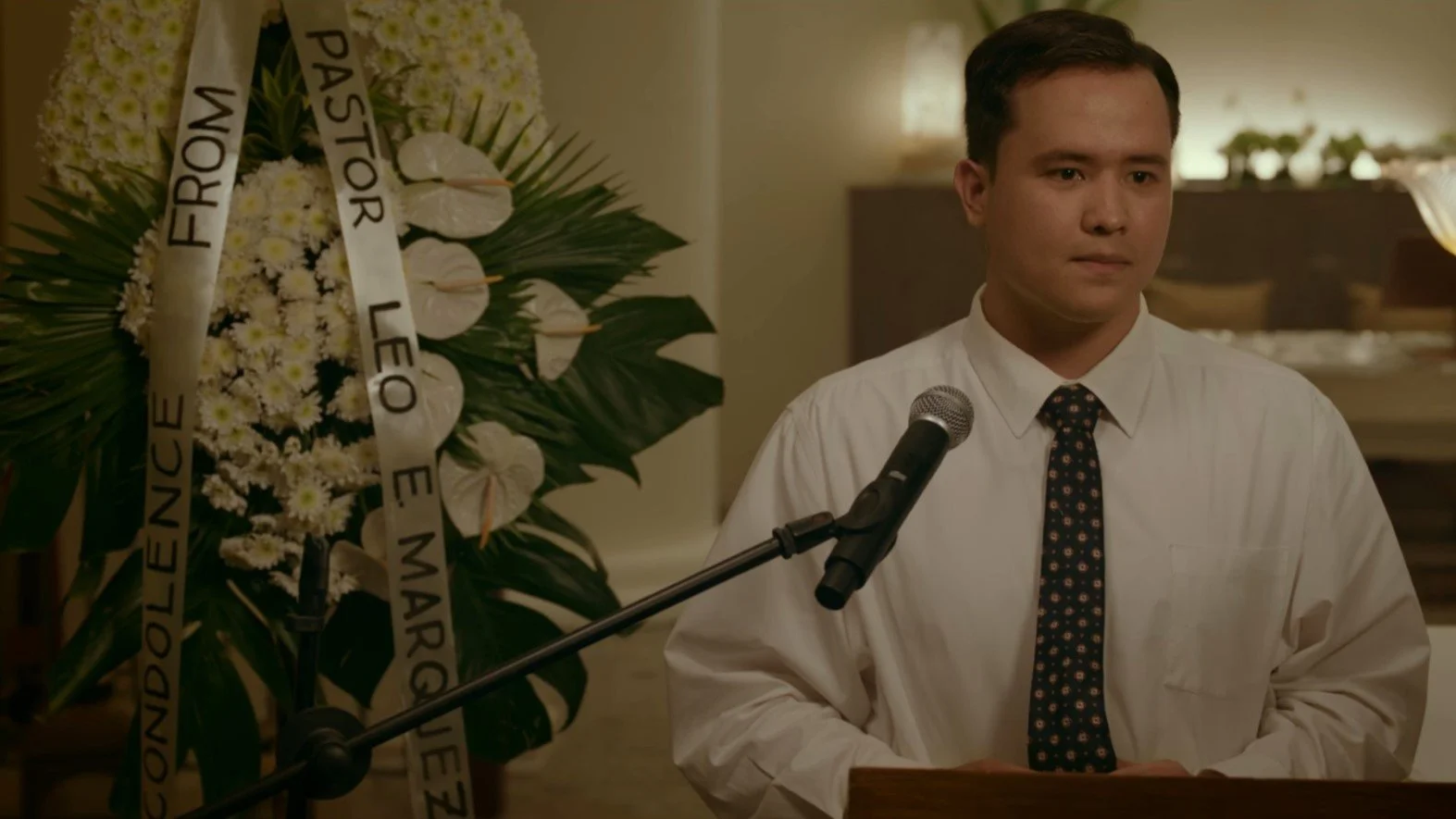
Seph (Juan Karlos Labajo) in Sana Sinabi Mo / Photo courtesy of Netflix
Conclusion
Giving this film a five-star rating is an understatement. It has been a long time since I watched something new and refreshing. JK Labajo is truly a great actor, and he gave justice and validity to Seph’s feelings, emotions, and experiences. Along with Otep’s representation in the film, Shaira Advincula directs us on the journey of life. Just because we could not choose the path we wanted does not mean it’s too late. Even more so, love knows no boundaries, even when time and distance get in the way.
Sana Sinabi Mo proves that a film’s power does not rely on connection and relatability — you do not need to relate to it to be able to love it. Rather, it invites you to reflect on everything the character experiences, from a personal perspective to a wider societal structure, shaping the choices we make. Do we truly have the freedom to choose our fate, or are we forever constrained by the circumstances and institutions around us?
Sana Sinabi Mo is available to stream on Netflix.