
In SLU-CCA's ‘The Hunchback of Notre Dame,’ the Top of the World and the Court of Miracles Meet in Baguio

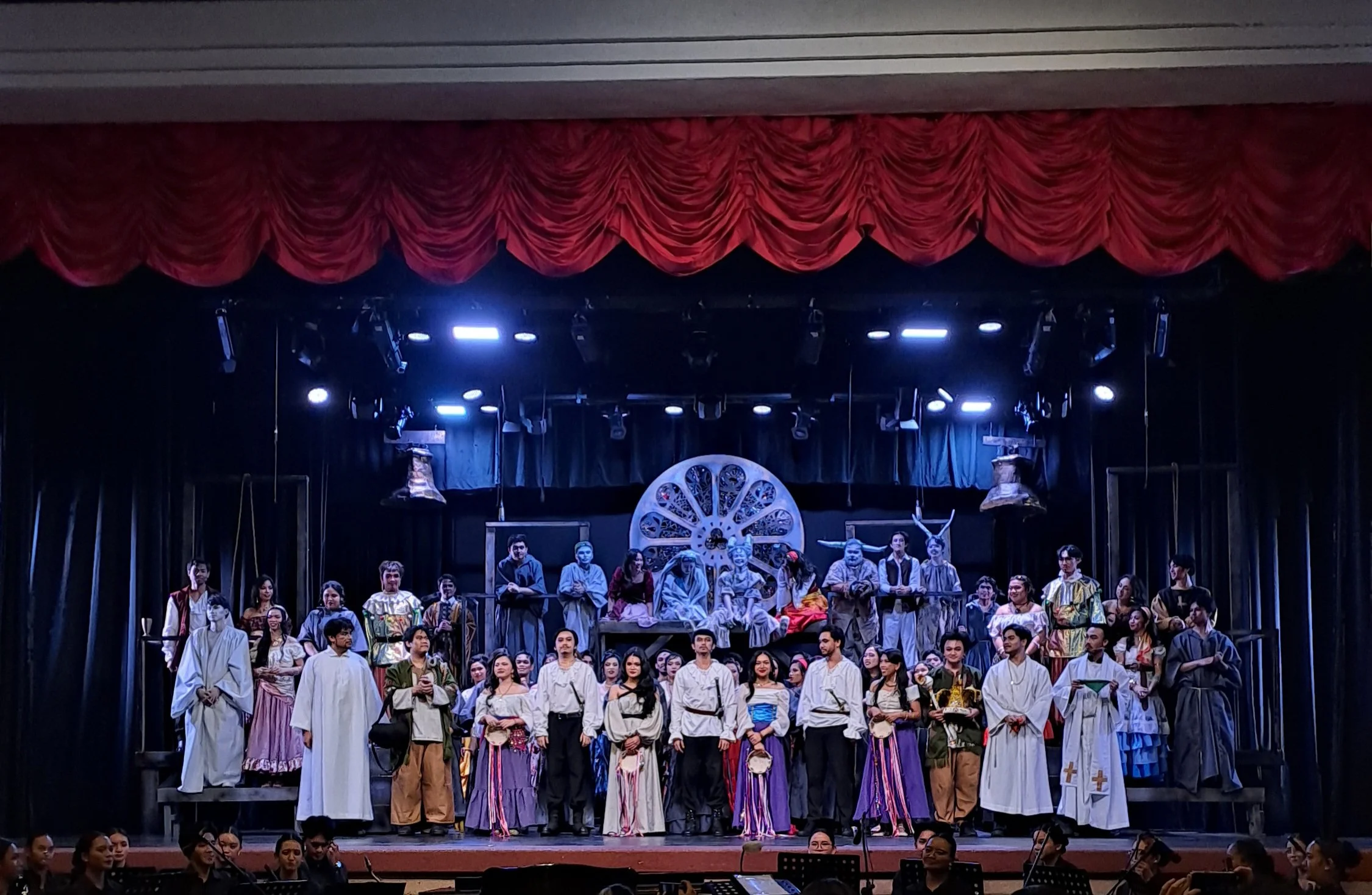
SLU-CCA'S ‘The Hunchback of Notre Dame’ Curtain Call
In the dark of night, where pleasure is fleeting and shadows conceal more than they reveal, lips meet and secrets unfurl. Beneath the vaulted space of Saint Louis University’s Fr. Joseph Van Den Daelen, CICM Center for Culture and the Arts Theater in Baguio City, the bells of Notre Dame ring—not only once, but across four sold-out nights from March 24 to 27.
From Paris to Baguio, a familiar story finds new life. The stage crowns its King of Fools, and with it comes a production unafraid to confront the uncomfortable. Religious institutions don’t often embrace narratives that question power from within, yet Saint Louis University’s Center for Culture and the Arts (SLU-CCA) dares to do just that. Through Disney’s The Hunchback of Notre Dame—adapted from The Hunchback of Notre Dame by Victor Hugo, with music by Alan Menken and Stephen Schwartz—the production unfolds as both spectacle and social commentary.
Bold in its execution, the musical wrestles with contradictions, injustice, lust, and even genocide. The Baguio-based theater transforms into the bustling streets of Paris and the towering heights of Notre Dame Cathedral. Here, audiences meets Quasimodo, the isolated bell-ringer, portrayed by Jiego Chua and Butch Wa-ayan; Esmeralda, the defiant gypsy girl, portrayed by Margaret Fernandez, Trisha Bugayong, Lilliane Dominguez, and Hannah Tahgubuan; and Claude Frollo, the archdeacon whose moral rigidity masks a dangerous inner fracture, portrayed by Clemuel Bautista, Carl Madlaing, and Huey Javier.
Frollo’s character becomes the production’s most unsettling mirror. The performance renders him with such depth and dimension that the actors disappear into the role, leaving only a wicked villain on stage. In his hands, authority is not merely just a power—it is protection from self-awareness. His obsession with Esmeralda fractures the identity he has carefully constructed: pious, disciplined, morally superior. Yet rather than confront this contradiction, he redirects blame outward, casting her as the source of his corruption.
In this descent, repression mutates into justification. Desire is labeled as sin; sin becomes accusation; accusation escalates into persecution. Frollo does not merely punish—he legitimizes violence under the guise of faith. What makes him terrifying is not the absence of belief, but the rigidity of it. He believes too completely in a version of himself that cannot afford to be wrong.
Beyond the cathedral walls, the city echoes with a haunting truth: “The wicked shall not go unpunished.” But the production dares to ask who, then, is truly wicked? Esmeralda’s prayer for the outcasts and kyrie eleison reverberates far beyond Paris, reaching into the mountains of the Cordillera. Her plea is not only for divine intervention, but for justice, for equality, for a people forced to fight for space in a world that denies their belonging.
Through the collective brilliance of Tanghalang SLU, the SLU Dance Troupe, SLU Glee Club, SLU Symphonic Band, and the SLU Concert Orchestra, the production achieves more than a retelling. It becomes a reflection. Not just of a distant Paris, but of present realities of power, prejudice, and the fragile line between righteousness and ruin.
The show leaves you with a moral, like a trinket you hold in your palm. And in the end, one riddle to guess if you can sing the bells of Notre Dame, long after the flip of the skirts:
What makes a monster, and what makes a man?
SLU-CCA's production of Disney's The Hunchback of Notre Dame, licensed by Music Theatre International, runs from March 24 to 27, 2026, at Saint Louis University's Fr. Joseph Van Den Daelen Theater as part of CCA's major production.